06 – Organization Chart & Access
The Mayflower organizational chart — who serves where, reporting relationships, and how leaders access the chart when making decisions or onboarding.
- Overview: Organization Chart & Access
- Volunteers
- Organization Chart and Access
- Team-to-Board Oversight Map
- Team Charters
- Team Charter Standard
- Evangelism Team Charter
- Worship Team Charter
- Audio-Visual Team Charter
- Scripture Reading Team Charter
- Prayer Team Charter
- Baptism Team Charter
- Missions Team Charter
- Shoebox Ministry Charter
- EQUIP Discipleship Charter
- Bible Fellowship Groups Charter
- Women's Ministry Charter
- Discipletown Charter
- Biblical Counseling Ministry Charter
- Hospitality Team Charter
- Nursery Team Charter
- First Impressions Team Charter
- Sanctuary Team Charter
Overview: Organization Chart & Access
Status
Implementation status: Approved by Servants Council
Date: 2026-05-30
Principle
Clarity about who serves where, who reports to whom, and how decisions flow is foundational to healthy operations. The org chart must be findable by leaders when they need it.
Mayflower's Current Practice
The organizational chart will be placed in a location that's accessible to all leaders.
Governance & Document References
- Mayflower Constitution and Bylaws — four boards (Elders, Deacons, Trustees, Finance)
- Mayflower Church Position Descriptions
Page template: Principle + Mayflower Practice. Part of the Operations Plan, adapted from Michael Lukaszewski's Streamline: How To Create Healthy Church Systems.
Volunteers
Volunteer ministry — the chapter document, weekly serving-team huddle guide, and check-in guide.
Volunteer Chapter
MAYFLOWER CHURCH
Volunteers
Streamline System 06 — Volunteers Chapter
April 2026
Governing Principle
Volunteers are not volunteers; they are ministers of the gospel.
“Volunteer” is a flat word from the corporate world. Scripture's word is “minister.” A child's Bible study leader is not someone who has volunteered to babysit; she is a minister of the Word entrusted with shaping the next generation. A Sunday usher is not someone who arrives early; he is a minister of welcome on the day God's people gather. The way we speak about service shapes the way our people experience it.
Purpose
This chapter documents how Mayflower Church identifies, invites, equips, and cares for the people who serve in its ministry teams. It sits inside System 06 (Organization Chart and Access) of the Mayflower Church Operations shelf, alongside the organizational chart and the meeting system. It is intended to be read by ministry team leaders, the boards that oversee them, and the Senior Pastor.
The chapter draws together two streams. Michael Lukaszewski's Streamline (chapters 18 to 20: recruit volunteers, write volunteer job descriptions, huddle with volunteers) provides the system shell — the discipline of naming a documented process, owning it, and reviewing it. Rick Howerton's Cracking the Volunteer Code provides the playbook that runs inside that system — the eleven foundational principles, the eight discovery methods, the five commitment categories, the five-phase recruitment journey, the nine-step ask, and the annual rhythms of retention. Both streams are anchored here in Mayflower's Five Priority Ministries and the Mayflower-specific oversight model.
How This Chapter Fits
- It sits inside System 06 — Organization Chart and Access.
- Volunteer job descriptions go in System 07 — Role Clarity and Standardization, beneath the existing 31 leader-level descriptions.
- The annual volunteer check-in is documented separately in the Volunteer Ministry Check-In Guide page, also inside System 06.
- Volunteers themselves are supervised through Mayflower's oversight-board model: each ministry team works with the board (elders, deacons, or trustees) that oversees their team or group.
Mayflower's Posture Toward Volunteers
“As each has received a gift, use it to serve one another, as good stewards of God's varied grace.” — 1 Peter 4:10
Service is part of discipleship, not an extra layer on top of it.
The New Testament knows nothing of Christians who attend without serving. Every member of the body has gifts; the church's job is to help those gifts find their use. When we invite someone to serve, we are not asking them to do us a favor — we are inviting them into the ordinary means by which Christ shapes them.
Anyone can serve at Mayflower; membership is required only to lead.
This is a deliberate Mayflower pattern. We do not gate serving on Foundations completion, baptism, or formal membership. The gate is leadership: to lead a team, a person must be a member in good standing. To serve on a team — to greet, to set up coffee, to rock a baby in the nursery, to read Scripture, to pray with a friend after the service — anyone is welcome. The one exception is service with minors: any role with regular access to children or youth first completes the screening process in the Volunteer Screening and Application — Service with Minors (System 13), including six months of regular participation at Mayflower.
Volunteers are ministers.
Reduce them to “volunteers” and you flatten what is actually happening. Use language that names the work for what it is. This carries through into how we recruit, train, supervise, and thank them.
Different commitment levels are equally valid.
Mayflower welcomes long-term and short-term commitments alongside one-time and on-call ones. None is more spiritual than the others. A grandmother who can serve once at the fall festival is making a real offering. A young father who can substitute in nursery on the weeks he is not on the road is doing real ministry. The aim is not to talk every member into a long-term role, but to find the role that fits the season.
The Five Commitment Categories
A persistent error in church recruiting is to ask for a long-term commitment when many people would gladly say yes to something smaller. Mayflower names five categories of commitment, and any role at the church can be filled in any of them:
- Long-term. On the team and committed to serving every time the role calls for service. These are the backbone — the people who will be there in October when summer enthusiasm has faded.
- Short-term. On the team for a defined season — a semester, a single ministry cycle, an event, or a special project. The role ends with the season; the person is not asked to keep going.
- Substitute. On the team and available to step in when someone else cannot. These are gold for any team that runs every Sunday — they keep the team from collapsing under attendance churn.
- On-call. On the team but with limited capacity. They will serve when asked, if they can, and the team leader knows not to be disappointed when life makes it impossible.
- One-time. Available and willing for one specific event. One-time service is not a stepping stone to long-term — it is real service, equally valid, with no implied next step.
When recruiting, name the category with the role. “Long-term First Impressions team member” is a different ask than “substitute Nursery worker on the weeks I am not on the road.” Many people who hesitate at the first will gladly say yes to the second.
Eleven Foundational Principles
Howerton names eleven principles that shape any healthy volunteer system. Mayflower adopts them in this language:
- People long to make a difference. The Spirit has placed in every believer a desire to contribute to something larger than themselves. Recruiting is not an imposition; it is the offering of an opportunity.
- Leaders build serve teams. Placeholders do not. Every team leader at Mayflower is responsible for actively recruiting, not waiting for volunteers to surface.
- People serve based on the time they have available. Match the role to the availability, not the other way around. Use the five commitment categories.
- Team leaders serve their volunteers passionately. Lead them. Pray for them. Advocate for resources. Celebrate them. Notice when they are tired.
- A placement system is essential. When someone says yes to “I'd like to serve,” there must be a clear next step. People fall through the cracks at the seam between interest and placement.
- People serve best in the role they are created for. Match passion and gifting to role. A person serving in their giftedness is sustainable; a person serving outside it is a recruitment problem waiting to happen.
- People won't flourish in a role they are not ready for. Some roles require maturity, training, or theological clarity. Naming those requirements is care for the person, not gatekeeping.
- Effective recruitment is face-to-face. Email, social media, and bulletin announcements have a place — but the actual yes happens in a personal conversation. Plan for the conversation.
- The more obstacles, the fewer volunteers. Distinguish between wise requirements (which protect the ministry and the person) and accumulated hoops (which drive willing servants away). Defend the first; remove the second.
- Volunteers are ministers. Reduce them to “volunteers” and you flatten what they are doing. Use the language that fits.
- Ministry teams work with the board that oversees them. Recruitment, retention, and development decisions happen in coordination with the relevant oversight board (elders, deacons, or trustees) — not as solo work by the team leader. This is a Mayflower-specific principle and replaces generic “supervisor” language in source material.
Discovery: Eight Ways to Find Volunteers
Most volunteer crises are not actually shortages — they are discovery failures. The people God is calling are usually already in the building; the team leader has not yet seen them or asked. These eight methods help reveal who is there. The team leader's task is to use several of them every year — different methods find different people.
1. Poll Bible Fellowship Group leaders.
BFG leaders know their groups in ways no one else does. They know who has been quietly growing, who is in a hard season, who is bored and ready for more, and who has gifts the rest of the church has not noticed. Schedule coffee with a BFG leader. Bring two copies of the group roster. Walk through the roster name by name and identify who is not currently serving. Ask the BFG leader where each person might fit. Pray together at the end.
2. Conduct a church-wide passion survey.
Once a year (or once every two years), survey the whole congregation about their passions. Howerton's questions are good starting points: What keeps you up at night? What would you do for free even if no one ever noticed? When you hear about a ministry, which one makes your heart beat faster? What problem in the world or the community would you most like solved? Then ask whether they are currently serving, whether they want to be contacted, and what fits their season. The aim is not placement; the aim is to surface latent passion the church can match to ministry.
3. Roam the church with eyes and ears wide open.
Many of the best volunteers are people you notice doing the right thing without being asked. The man who is always early. The woman who notices when someone is sitting alone. The teenager who keeps quietly cleaning up after coffee. Notice them. Approach them. The conversation that starts with “I have been watching you for months and you are exactly what we need” is powerful in ways a cold ask never will be.
4. Host an interest gathering.
Pull together a small group of people the team leader believes might fit a particular role. Send a personal invitation three weeks ahead. Serve food. Walk them through the role honestly. Allow time for questions. Follow up individually within 48 hours. Some will say yes that night; others need time. Both responses are normal.
5. Brainstorm with present team members.
The people already on the team are the church's best scouts. They know who in the congregation shares their passion. Once a year, hold a brainstorming session where current team members name the people they wish were on the team. Ask the team to take responsibility for inviting those people, with the team leader's support.
6. Bring a Friend Day.
Invite each current volunteer to bring one friend to a service or to a team gathering. The friend is not pressured to join; they are simply exposed to the team. Some will return next month asking how to get involved.
7. Review the church roll.
Walk through the membership and attendance roll annually. Look for patterns: who has been attending without serving? Who used to serve but stepped back? Who has joined recently and has not yet been invited into anything? The roll surfaces the obvious cases that bulletin announcements miss.
8. Lightning strikes.
Sometimes the Spirit hands a name to a team leader without warning. Pray about it; if it stays, ask. Some of the best hires in the church's life come this way.
Recruitment: The Five-Phase Journey
A common mistake in church recruitment is to compress the entire journey into one ask: “Hey, can you be a small group leader?” delivered in the lobby on a Sunday. People decline these asks not because they are not called, but because they have not been led through the journey. There are five phases. Each requires something distinct from the recruiter.
Phase | Volunteer's Need | Recruiter's Job |
|---|---|---|
Awareness | To know an opportunity exists | Promote, mention, surface the need |
Invitation | To be invited to a real conversation | Reach out personally |
Meeting | To learn what the role actually involves | Lead the meeting; name the role plainly |
Contemplation | Time to pray and decide | Be available; answer questions when asked; do not press |
Commitment | An invitation to say yes | Ask plainly; hear the answer; follow up within 48 hours |
The team leader who jumps from Awareness straight to Commitment will recruit very few people. The team leader who walks people through all five will recruit many.
The Ask: Nine Steps
Inside the Meeting phase — and adaptable to a one-on-one conversation, a small gathering, or a large recruitment event — the ask itself has nine steps. These are not a script to be read aloud; they are a sequence to make sure nothing important gets skipped.
- Reveal the ministry's vision. What is this team trying to see God do? Cast it briefly and clearly.
- Share the ministry's goal. What do we hope to accomplish in the next twelve months that fits inside that vision?
- Tell a story of a transformed life. A real person whose life has been touched through the team's work.
- Explain why the ministry is essential. Why does this matter at Mayflower right now? How does it strengthen one of the Five Priority Ministries?
- Outline what the role entails. Walk through the written job description (see “Volunteer Job Descriptions” below). Be honest about the time commitment.
- Make an “I see in you” statement. Tell them specifically why you, after prayer, believe they would be a good fit. This is not flattery — it is honest naming. Specifics matter: “I see in you a gentleness with children that the toddler room needs.”
- Q and A. Answer questions. Be willing to say “I do not know — let me find out and get back to you.”
- Seek a commitment. Be plain. Some people will say yes on the spot. Others need time. Either is fine.
- Follow up within 48 hours. This is the step most often skipped, and it is the one that closes the most yeses. End every meeting by saying when you will follow up, and then do it.
Three Settings for the Ask
The same nine steps adapt to three settings:
- One-on-one. The most effective. Coffee, lunch, or a walk. Reserve for roles that warrant the investment of personal time, and for people you have already prayed about.
- Small gathering of fewer than eight. Useful when you need to cover several roles at once. Send a clear invitation three weeks ahead; serve food; run the nine steps for the room; allow time for individual follow-up.
- Large gathering. A whole-team or whole-church recruitment event. Less personal, but useful for surfacing interest. The same nine steps still apply; the follow-up phase becomes one-on-one.
The one constant: face-to-face. A bulletin announcement is not recruitment; it is awareness.
Wise Requirements vs. Obstacles
Every requirement to serve is a friction point. Some friction is necessary; some is accumulated cruft. The question to ask: does this requirement protect the ministry, the people being served, or the volunteer themselves? If yes, keep it. If no — if it merely makes the team leader feel responsible — remove it.
Wise requirements at Mayflower
- A signed application and CORI background check for any role with regular access to minors.
- Mayflower's child and youth safety training for those same roles, on the schedule the church specifies.
- Theological alignment with Mayflower's Statement of Faith for any role that teaches doctrine.
- Membership in good standing for any role that leads a team. (Service does not require membership; leadership does.)
These bullets are a summary only. The full process for service with minors — application, three references, CORI and SORI checks, an interview, a signed Code of Conduct, the church's child and youth protection training, and written approval, with annual renewal — is defined in the Volunteer Screening and Application — Service with Minors (System 13 — Church Safety), which governs where they differ.
Obstacles to remove or simplify
- Pre-reading lists for entry-level service roles.
- Long approval chains for what should be a team-leader decision.
- Required training experiences disconnected from the role itself.
- Vague “discipleship prerequisites” that no one can quite articulate.
When in doubt, ask whether the requirement serves the ministry or the person. Drop the rest.
Volunteer Job Descriptions
Every volunteer role at Mayflower needs a written job description — not because we are bureaucratic, but because clarity is care. A volunteer who knows what they are doing serves with confidence. A volunteer who is guessing serves with anxiety.
Mayflower's volunteer job descriptions sit in System 07 — Role Clarity and Standardization, beneath the existing 31 leader-level descriptions. The seven fields are the same for every volunteer role:
- Role Title. Specific. “Kids Ministry Greeter” rather than “kids volunteer.”
- Purpose of the Role. One sentence on what this role contributes to the team's mission. Connects to one or more of the Five Priority Ministries where possible.
- Primary Responsibilities. The actual day-to-day work, in plain language. Bulleted, not paragraphic.
- Requirements. Wise requirements only. Background check (where applicable), specific training, etc.
- Leader. Name and contact for the team leader the volunteer reports to.
- Training Expectations. What training is mandatory, what is optional, when each occurs.
- Time Commitment. Hours per week, ministry schedule, term length (ongoing, semester, single event).
The leader-level descriptions describe the team-leader role (e.g., “Worship Team Leader”). The team-member descriptions describe the volunteer roles inside the team (e.g., “Worship Team — Acoustic Guitar,” “Worship Team — Vocals,” “Worship Team — Setup Assistant”). Both belong in System 07.
Retention: Annual Rhythms
Recruitment is the front door. Retention is everything else. Volunteers stay where they are appreciated, equipped, and connected. Mayflower's retention rhythm has seven elements, woven through the year:
- Annual vision casting. Once a year — typically at the August Leadership Summit or at a team-specific kickoff — the team leader paints the vision for the year ahead. History (where we have been), vision (what God is calling us toward), purpose (why it matters), truth (where we have fallen short and what is changing), strategies (what is new), challenge (what is being asked), story (a life transformed), goals (the year's God-sized ambitions), and roles (how each volunteer fits).
- Fellowship experience. Once a year, volunteers gather for something fun and unstructured — a picnic, a game night, a meal at the pastor's home. Not a meeting. Not a training. A relationship.
- Huddles. Small, frequent gatherings of fewer than eight from the same role, where the team leader affirms the volunteers, surfaces wisdom, identifies leadership potential, and inspires one another. The weekly Sunday pre-service huddle (below) is one form of this; longer huddles by ministry area happen periodically through the year.
- Listening sessions. Periodic gatherings where the leader's job is to listen, not teach. What is working? What is hard? What would you change if you could?
- Appreciation. Regular, specific, named appreciation. “I noticed how you handled that family last Sunday” is worth more than a generic thank-you in a newsletter.
- Celebration. Public moments where God's work through the team is named and rejoiced over.
- Skill building. Ongoing development. Every volunteer should have access to training that helps them serve better — and being given that training is itself a sign that the team takes them seriously.
The Weekly Pre-Service Huddle
Mayflower runs a weekly pre-service huddle for serving volunteers before the Sunday morning service. Its purpose is small and important: review the service plan, answer questions, and pray together as one team before the service begins.
- Attendees: All volunteers serving in any role for that morning's service — First Impressions, Hospitality, Audio-Visual, Nursery, Worship Team, Scripture Reading, ushers, and any rotating roles.
- When: Every Sunday morning at 9:35 a.m., before the morning service.
- Where: Briggs Fellowship Hall.
- Led by: The First Impressions Team Leader.
- Format: Brief — long enough to align, answer questions, and pray, short enough that no one is rushed into their role.
- Guide: The huddle is led using the Service Huddle Guide created by the Pastor — which provides the prayer points and structure week to week.
Standard Agenda
- Welcome and brief connection.
- Review the service plan — what is happening this morning, in what order, with any service-specific notes (a guest speaker, a baptism, a planned sermon emphasis the team should know about, a logistical wrinkle).
- Questions answered. Anything the team needs clarified before the service begins.
- Prayer — using the Service Huddle Guide, the leader prays for the ministry of the teams serving and for the whole service.
- Send into the morning.
The Annual Check-In
Once a year, every team leader sits down with each of their volunteers for an annual check-in. This is not a performance review; it is a pastoral conversation about how God is meeting them in the place they serve.
The full guide is documented separately in Volunteer Ministry Check-In Guide — April 2026 on BookStack (System 06). The four-question frame:
- Are you still enjoying this?
- Is this sustainable in your season?
- Is God doing anything in you through this?
- What do you want the next year to look like?
The aim is appreciation and honesty, not assessment. A healthy ministry has people rotating in and out across the year, and the check-in makes those rotations easy rather than painful.
The Growth Funnel: How We Improve
Two practices keep the volunteer system honest over time.
Exit interviews.
When a volunteer leaves a team, the team leader has a brief conversation about the experience. What prompted the decision? What worked? What did not? What would have kept you? The aim is not to talk anyone out of leaving; it is to learn.
Annual ministry survey.
Once a year, every active volunteer completes a brief survey on the health of the team they serve in. Vision clarity, culture, communication, recognition, training, and decision-making quality are all reasonable areas to ask about.
The “funnel” name matters: not every piece of feedback should produce a change. The team leader runs feedback through a funnel, removing what is idiosyncratic or one-off and acting on what is recurring. Only when the same concern surfaces from multiple voices over time should the leader change the system.
Supervision: The Oversight-Board Model
At Mayflower, ministry teams do not work in isolation. Each team is overseen by one of three boards — elders, deacons, or trustees — based on the nature of the team's work:
- Pastoral, discipleship, and Word-shaped teams typically sit under the elders.
- Service, hospitality, and care-shaped teams typically sit under the deacons.
- Facility, finance, and property-shaped teams typically sit under the trustees.
The team leader's first call for supervision, succession, recruitment escalation, and leader development is the board that oversees their team. The Senior Pastor remains a resource and holds general oversight of the staff and pastoral life of the church, but the day-to-day supervision relationship runs through the relevant board.
Sources
- Streamline: How to Create Healthy Church Systems — Michael Lukaszewski (chapters 18, 19, 20).
- Cracking the Volunteer Code: Revealing, Recruiting, and Retaining Volunteers — Rick Howerton (Chapter 1: 11 Foundational Principles; Chapter 4: Hidden Gems; Chapter 5: The Art of the Ask; Chapter 6: Beyond the First Yes; Chapter 7: The Growth Funnel).
- Volunteer Ministry Check-In Guide — April 2026 (Mayflower BookStack, System 06).
- Mayflower Constitution and Bylaws — for membership and leadership requirements.
- Five Priority Ministries We Guard (Mayflower BookStack, System 01) — for the framing of why volunteer recruitment ultimately serves.
Serving Team Huddle Guide — Template
MAYFLOWER CHURCH
Serving Team Huddle Guide
Streamline System 06 — Sunday Morning Pre-Service Huddle: Use, Template, and Example
April 2026
About the Huddle
Purpose
The Sunday morning huddle exists for one small and important reason: every volunteer serving on a given morning gets the same picture of what is happening, the same chance to ask questions, and the same prayer over them before the service begins. Five to ten minutes of alignment turns ten or fifteen people in different rooms into one team.
Who, When, Where
- Attendees: All volunteers serving in any role for that morning's service — First Impressions, Hospitality, Audio-Visual, Nursery, Worship Team, Scripture Reading, ushers, and any rotating roles.
- When: Every Sunday at 9:35 a.m., before the morning service.
- Where: Briggs Fellowship Hall.
- Led by: The First Impressions Team Leader.
- Length: Brief. Long enough to align, answer questions, and pray; short enough that no one is rushed into their role.
The Flow
The First Impressions Team Leader runs the huddle in this order each week:
- Welcome and brief connection. Greet the team. Thank them. Notice who is here.
- Review the service plan. Walk through what is happening this morning, in what order. Name service-specific notes — a guest speaker, a baptism, a planned sermon emphasis the team should know about, a known logistical wrinkle.
- Questions answered. Anything the team needs clarified before the service begins.
- Walk through this week's Huddle Guide and pray. The Pastor sends a Huddle Guide for each sermon early in the week prior. The Guide has a stable form (below) — three things for the team to carry into the morning. The leader reads through the Guide with the team and prays accordingly: for the ministry of the teams serving and for the whole service.
- Send into the morning. End on time. Get the team to their posts.
About This Guide
The Serving Team Huddle Guide is created by the Pastor with each sermon and sent to the First Impressions Team Leader early in the week prior to the service. The structure is stable, week to week — three named points (Pray, Engage, Expect God to do great things) with an opening welcome and a closing send. The content under each point is fresh, drawn from that Sunday's sermon and what the Pastor is asking God to do in the room.
Because the form is stable, anyone — a guest preacher, a substitute pastor, or a future Senior Pastor — can fill it in without inventing a format. That is the point of writing it down.
If the Pastor Is Unavailable
When a guest preacher or substitute is preaching, that preacher (or the Senior Pastor in advance, if known) drafts the Guide using the template below. If no Guide arrives by Saturday, the First Impressions Team Leader runs the huddle in the standard flow above and prays from the sermon passage directly. The huddle never stops because the Guide did not.
The Template
What follows is the stable structure of the Serving Team Huddle Guide. The constants (opening line, three named points, closing line) stay as written. The bracketed instructions show what to fill in each week, anchored to that Sunday's sermon.
Type the sermon title and passage where indicated, then write 3 to 5 sentences under each of the three named points. The closing line is constant. Send to the First Impressions Team Leader by mid-week.
Serving Team Huddle Guide [Sermon Title — Passage Reference] ——— Good morning, team. Thank you for being here to serve today. Before we head to our posts, here are three things to carry with you this morning. Pray. [Three to five sentences. Connect this morning's sermon to specific prayer points for the people walking through our doors today. Name what God might be doing in the room — the first-time visitor, the long-time attender still waiting on a word from God, the family in a hard season. Anchor the prayer in the sermon text.] Engage. [Three to five sentences. Use a sermon image, character, or moment to call the team to active engagement — looking for the person standing alone, the family unsure where to go, the visitor scanning the room for a familiar face. Connect their faithful, behind-the-scenes serving to the way the gospel actually reaches people.] Expect God to do great things. [Three to five sentences. Connect what God did in or through the sermon's text to what we believe God can do here, today. Be specific to Kingston, specific to this service. Expectation, not hype.] Let's pray together and then go serve with joy. |
Notes on Filling In the Template
- Length per point. Three to five sentences. Long enough to land; short enough that the team can hold it in their head while they serve.
- Anchored in the text. Each point should rise out of the sermon. Pray prays the sermon's hope. Engage uses the sermon's imagery. Expect names what the sermon makes possible. The Guide is the sermon's rehearsal in the volunteers' bodies before the congregation hears it preached.
- Specific to today. Real people, real doors, real Kingston. The Guide is not a meditation; it is a deployment.
- Constants stay constant. The opening line, the three named point words (Pray / Engage / Expect God to do great things), and the closing line do not change. The team comes to recognize the rhythm. That recognition is part of the formation.
Worked Example
Below is the Serving Team Huddle Guide for "Jesus Still Heals" — Acts 9:32–35, reproduced as the Pastor sent it. It is included here so a future writer can see what a filled-in Guide looks like in practice.
Serving Team Huddle Guide Jesus Still Heals — Acts 9:32–35 ——— Good morning, team. Thank you for being here to serve today. Before we head to our posts, here are three things to carry with you this morning. Pray. This morning's sermon is about a paralyzed man who had been stuck on a mat for eight years — and the risen Jesus who healed him through the ordinary visit of an ordinary servant. Someone walking through our doors today may have been on their own mat for a long time. Pray that God would use this service to speak his healing word over them. Pray for the person who almost did not come, the one who is here for the first time, and the one who has been coming for years but is still waiting to hear Christ say, "Rise." Ask God to move powerfully through his Word and through our welcome. Engage. Peter did not wait for Aeneas to come to him. He went to Lydda. He walked into the room. Today, you are the feet of Christ on this campus. Look for the person standing alone, the family that seems unsure where to go, the visitor scanning the room for a familiar face. Walk over. Introduce yourself. Show them they are seen. A warm greeting and a genuine conversation can be the very means by which the risen Jesus makes a house call to someone who has been lying on a mat. Expect God to do great things. When Aeneas rose, the whole region of Lydda and Sharon turned to the Lord. One healing in one small town became a gospel movement across a thirty-mile stretch of coastline. Do not underestimate what God can do through one faithful Sunday in Kingston. The same Jesus who healed Aeneas is present in this room today. Expect him to speak. Expect him to heal. Expect lives to change — and expect that your faithful, behind-the-scenes serving is part of how he does it. Let's pray together and then go serve with joy. |
Notes for the Pastor or Guest Writer
- Send the Guide to the First Impressions Team Leader by mid-week of the week prior to the service.
- Plain-text or markdown is fine. The team will read it aloud, not print it.
- If the sermon shifts during the week, send an updated Guide. The huddle will use the latest version.
- Each point earns its place by being anchored in the sermon. If a point could have been written for any sermon, rewrite it for this one.
Notes for the Huddle Leader
- Read the Guide before Sunday morning. Do not see it for the first time at 9:35.
- Read it to the team verbatim where helpful, paraphrase where natural. The words matter; the rhythm matters more.
- Pray the Guide. The three points are not a devotional — they are a deployment. Pray the team into the morning.
- Keep the huddle to its time. Send the team out at or before the hour.
See Also
- Mayflower Volunteer Chapter — April 2026 (BookStack, System 06) — for the full picture of how the huddle fits inside Mayflower's volunteer rhythms.
- Mayflower Meeting System — April 2026 (BookStack, System 06) — for how the huddle relates to the broader meeting architecture.
- Five Priority Ministries We Guard (BookStack, System 01) — the huddle is a small but real expression of Priority 2 (the Lord's Day Gathering) and Priority 3 (Gospel-Driven Prayer).
Volunteer Ministry Check-In Guide
MAYFLOWER CHURCH
Volunteer Ministry Check-In
A guide for ministry team leaders
Purpose
At Mayflower, volunteers are not a workforce. They are members of the body using their gifts for the building up of the church. That means the way we “evaluate” them is different in kind from how we evaluate staff or officers. It is not a review at all — it is a check-in between a team leader and a team member, once a year, over coffee, about how God is meeting them in the place they serve.
This is the single most important paragraph in this guide: if your volunteer walks away from this conversation feeling scored, you have done it wrong.
Posture
- Appreciation first. Before anything else, tell them specifically what you have seen and what you are thankful for. Specifics matter.
- Curiosity, not audit. You are trying to understand their life and how this ministry fits inside it — not inspect their service.
- Clear off-ramps. A good check-in makes it easy for someone to say, “I need to step back this season” without guilt. Healthy ministries have people rotating in and out. That is not failure; that is how the body works.
- No paperwork. This guide is for you, the team leader. You do not fill it out with the volunteer and hand it to an administrator. The only thing you track is your roster — who is in, out, resting, or moving — and anything that needs to be escalated to an elder for pastoral care.
When and how to do it
- Once a year per team member. Pair it with a natural rhythm — after a ministry season ends, after the summer break, before Back to Church Sunday.
- Face to face where possible. Coffee, a meal, a short walk, the lobby after church. Not text, not email, not a form.
- Twenty to forty minutes. Long enough to go beyond pleasantries, short enough to not feel like an appointment.
- In person with their spouse, when it helps. For roles that impact family rhythm (worship team, A/V, hospitality on Sundays), asking their spouse's read on the season is wise.
The Conversation
A simple four-question frame. Use it as a guide, not a script. Follow what God is actually doing in this person.
1. Are you still enjoying this?
Not “you're still doing a good job, right?” Literally — is there joy when you show up, or has this become a grind? If it has become a grind, is that because the work is costly (and good) or because the fit is off (and we should talk about that)?
2. Is this sustainable in your season?
Ask about their life outside the church. New baby, caregiving for a parent, a hard season at work, a difficult stretch at home, a health thing they haven't told anyone. What would need to be true for this ministry to remain life-giving for them this year?
3. Is God doing anything in you through this?
A church volunteer role is not just a service arrangement. It is a place of discipleship. Ask honestly — how is serving on this team shaping your walk with Jesus? Where is He meeting you? Where is He stretching you?
4. What do you want the next year to look like?
Is the answer “more of the same”? Great. Is it “I want to grow into more responsibility”? Let's talk about that. Is it “I need a break”? Let's plan that. Is it “I want to rotate to another ministry”? Let's make that easy. All four answers are equally valid.
Three things to listen for
- Quiet fatigue. People will not always say they are tired. Look for shorter answers than usual, distance from the team, or the tell-tale “I'm fine” when the person's eyes say otherwise.
- Growth hunger. Some people on your team are ready for more. If the check-in reveals that, name it. Don't starve a volunteer's maturing by keeping them in the box where you found them.
- Pastoral issues beyond your pay grade. If the conversation surfaces something that needs elder-level shepherding — a marriage crisis, depression, doctrinal confusion, a relational fracture in the church — gently let the person know you would like to connect them with a pastor or counselor. Do not try to carry it as a team leader.
After the Conversation
- Update your roster. Who is continuing, rotating, resting, stepping up, stepping down?
- Follow through on anything you committed to. If you said, “I'll get you training on X,” do that within two weeks or tell them why not.
- Pray for them by name this week. Specifically, for what they told you.
- Escalate with care. If the conversation surfaced a pastoral need, reach out to the Senior Pastor or an appropriate elder with the person's awareness.
- Do it again next year. The value of this rhythm is in the repetition, not in any single conversation.
Card for Team Leaders
You can print the page below as a single-card reminder and tuck it in a notebook or bulletin.
MINISTRY CHECK-IN Once a year. Over coffee. Appreciation first. 1. Are you still enjoying this? 2. Is this sustainable in your season? 3. Is God doing anything in you through this? 4. What do you want the next year to look like? Listen for quiet fatigue. Listen for growth hunger. Escalate what is beyond your pay grade. Pray by name. |
Organization Chart and Access
MAYFLOWER CHURCH
Organization Chart & Access
Approved by Servants Council on July 11, 2026
Governing Principle
Clarity about who serves where, who reports to whom, and how decisions flow is foundational to healthy operations. The org chart must be findable by leaders when they need it — not buried in a folder, not pieced together from memory, but a single, current, authoritative picture of how Mayflower is organized.
A church that cannot see itself cannot lead itself. The organizational chart, kept current and kept accessible, is the picture by which staff, officers, board members, and ministry leaders see the body of which they are a part — and locate themselves within it.
Mayflower's Current Practice
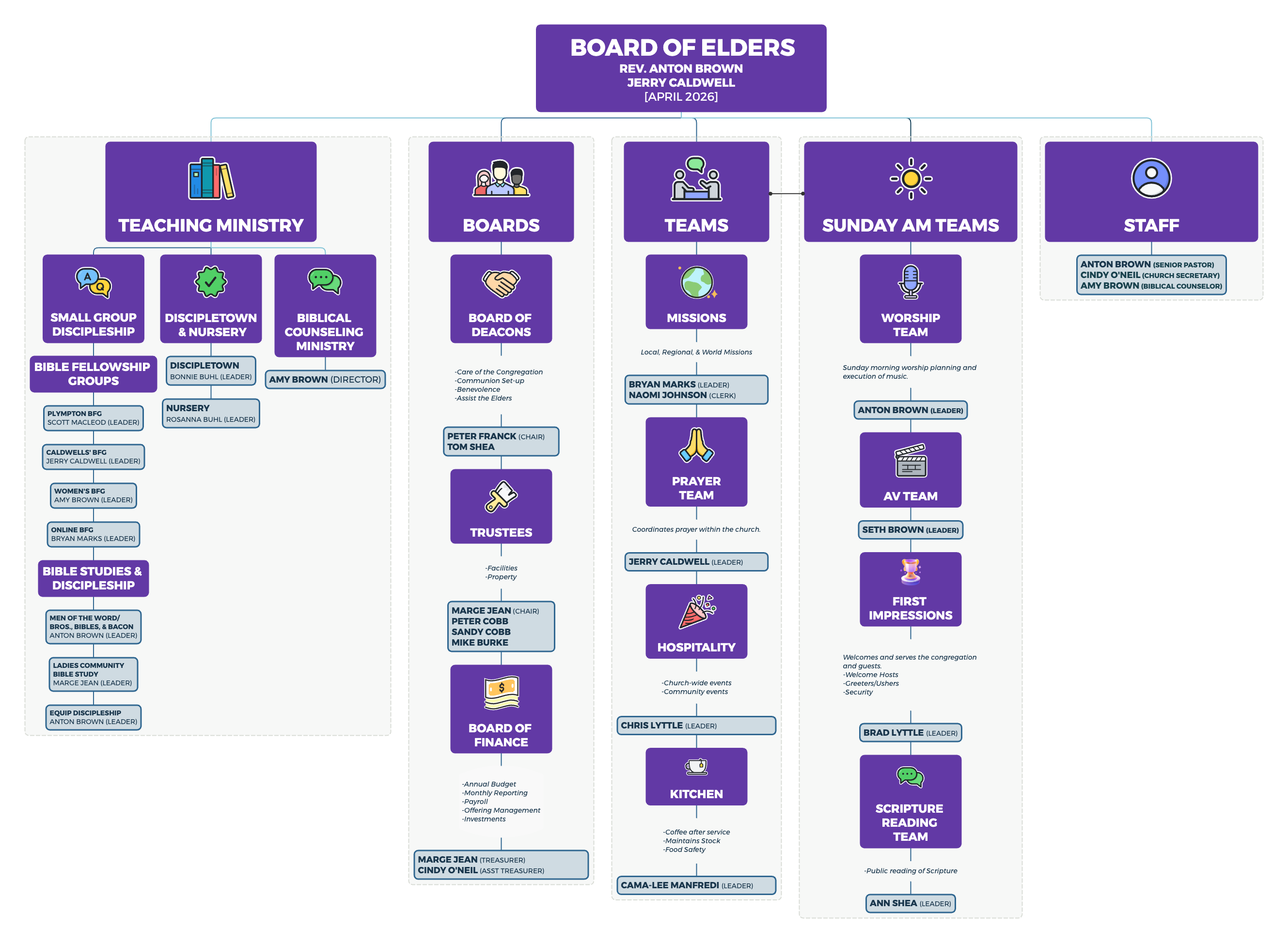
Mayflower Church maintains a current organizational chart depicting the four boards established by the Mayflower Constitution and Bylaws (Elders, Deacons, Trustees, Finance), the Senior Pastor and church staff, the Sunday morning teams, and the ministry teams that operate beneath each board. The chart names the leader of each team and group, so that any staff member, officer, or member of the congregation can identify who carries responsibility for a given area.
The chart is placed in a location that is accessible to all leaders. The current revision is reproduced below. The authoritative record is a single roster file kept with the church's operations records; the chart on this page is generated from that file rather than drawn and posted separately. A change to boards, staff, or team leadership is made in the roster file first, and this page is then regenerated from it, so the picture shown here and the record behind it cannot drift apart.
Mayflower Church Organization Chart
Organization chart, current as of 2026-07-30. Generated from the roster data file — edit there, not here.
Jerry Caldwell
TEACHING MINISTRY Bible Fellowship Groups Caldwells' BFG Jerry Caldwell (Leader) Women's BFG Amy Brown (Leader) Online BFG Bryan Marks (Leader) Bible Studies & Discipleship Men of the Word / Brothers, Bibles & Bacon Anton Brown (Leader) Ladies' Community Bible Study Marge Jean (Leader) EQUIP Discipleship Anton Brown (Leader) Nursery Rosanna Buhl (Leader) Biblical Counseling Ministry Amy Brown (Director) | BOARDS Board of Deacons Care of the congregation; communion set-up; benevolence; assist the elders Peter Franck (Chair) Tom Shea Brad Lyttle Chris Lyttle Trustees Facilities; property Marge Jean (Chair) Peter Cobb Sandy Cobb Mike Burke Board of Finance Annual budget; monthly reporting; payroll; offering management; investments Marge Jean (Treasurer) Cindy O'Neil (Asst Treasurer) | TEAMS Missions Local, regional & world missions Bryan Marks (Leader) Naomi Johnson (Clerk) Prayer Team Coordinates prayer within the church Jerry Caldwell (Leader) Hospitality Church-wide events; community events Chris Lyttle (Leader) Kitchen Coffee after service; maintains stock; food safety Cama-Lee Manfredi (Leader) | SUNDAY AM TEAMS Worship Team Sunday morning worship planning and execution of music Anton Brown (Leader) A/V Team Seth Brown (Leader) First Impressions Welcome hosts; greeters & ushers; security Brad Lyttle (Leader) Scripture Reading Team Public reading of Scripture Nancy Troup (Leader) | STAFF Staff Anton Brown (Senior Pastor) Cindy O'Neil (Church Secretary) Amy Brown (Biblical Counselor) |
Figure 1 — Mayflower Church Organization Chart.
Reading the Chart
The chart is organized around the Board of Elders at the top, with five working columns flowing beneath it. Each column represents a domain of the church's life. The chart should be read alongside the Mayflower Constitution and Bylaws (which establishes the four boards) and the Mayflower Church Position Descriptions (which define each role).
Teaching Ministry
Bible Fellowship Groups (Caldwells', Women's, Online), the Bible Studies and Discipleship cohort (Men of the Word, Brothers Bibles & Bacon, Ladies' Community Bible Study, EQUIP Discipleship), the Nursery, and the Biblical Counseling Ministry. Spiritual oversight rests with the Elders.
Boards
Board of Deacons (care of the congregation, communion setup, benevolence, assisting the elders); Trustees (facilities and property); Board of Finance (annual budget, monthly reporting, payroll, offering management, investments). Each board's authority is defined in the Mayflower Constitution and Bylaws.
Teams
Missions (local, regional, world); Prayer Team (coordinating prayer within the church); Hospitality (church-wide events, community events); Kitchen (coffee after service, mainstays stock, food safety). These are the standing ministry teams that operate week to week.
Sunday AM Teams
Worship Team (Sunday morning worship planning and execution of music); A/V Team; First Impressions (welcomers, greeters and ushers, security); Scripture Reading Team (public reading of Scripture). These are the teams that make Sunday morning happen.
Staff
Senior Pastor; Church Secretary; Biblical Counselors. Staff roles, position descriptions, and reporting are governed by the Mayflower Church Position Descriptions and the Employee Handbook.
Access and Maintenance
How This Chapter Fits
- It is the umbrella of System 06. The detailed meeting architecture lives in the Meeting System book (April 2026); the volunteer and team-leader chapter lives in System 06 — Volunteers. Together, this overview and those chapters describe how Mayflower is organized in space and how it operates in time.
- It is read with the bylaws. The four boards depicted on the chart are established by the Mayflower Constitution and Bylaws; their authority and limits are defined there.
- It is read with the position descriptions. Roles named on the chart correspond to the Mayflower Church Position Descriptions, which define the responsibilities, qualifications, and reporting line of each role.
- It connects to other systems. Decision authority for each box on the chart is governed by System 09 — Decision-Making Framework; the calendar that holds each body's meetings is built through System 04 — Master Calendar Integration; goals are refreshed at the gathering described in System 14 — Annual Goals.
Document Control
Approval: Servants Council; revisions ratified at the next quarterly meeting.
Review cadence: Annually, prior to the August Leadership Summit; and whenever boards, staff, or team leadership changes.
Next scheduled review: August 2026 Leadership Summit — and immediately upon any change to boards, staff, or team leadership.
Sources
- Mayflower Constitution and Bylaws — establishes the four boards.
- Mayflower Church Position Descriptions — defines each role on the chart.
- Streamline: How to Create Healthy Church Systems — Michael Lukaszewski (System 06).
- Meeting System (its own book, April 2026) — companion chapter on cadence and architecture.
Team-to-Board Oversight Map
MAYFLOWER CHURCH
Team-to-Board Oversight Map
Streamline System 06 — Which Board Oversees Which Ministry Team
Approved by the Servants Council on July 11, 2026. Standing map, reviewed annually before the August Leadership Summit.
Governing Principle
Every team has a home.
When a ministry team leader has a question, a need, a candidate to recruit, or a problem to solve, they should know — without asking — which board they go to first. This document is that answer. It replaces the “Ministry Coach” role that was proposed but not approved, by naming the standing board that already has bylaw oversight of each team's work.
Purpose
This chapter maps each Mayflower ministry team to the board (Elders, Deacons, or Trustees) that oversees its work. It is the operational implementation of the principle that ministry teams work with the board that oversees their team or group, and it pairs with the Volunteers chapter and the Meeting System chapter inside System 06.
It draws first from the Mayflower Constitution and Bylaws, which name explicit areas of oversight for each board. Where the bylaws are explicit, the bylaws govern. Where the bylaws are silent, this document offers a recommendation grounded in the nature of the team's work and Mayflower's existing practice; those recommendations are flagged for elder approval.
What the Bylaws Say
The October 2024 bylaws (Article II, Section B) assign explicit areas of ministry oversight to each board. The relevant text is summarized here so this document can stand on its own.
Board of Elders (Article II, Section B, 1.c)
The Elders oversee the spiritual life of the church. The bylaws name as their explicit responsibility:
- The teaching, outreach, and worship ministries of the church.
- Adult and youth Christian Education, worship and music, Bible Fellowship Groups, missions, outreach, assimilation, baptism, and discipleship.
- The Audio/Visual Team — by direct, named bylaw reference (Article II, Section B, 1.c.4).
- Approval of the establishment and participants in all church-related Ministry Teams (Article II, Section B, 1.c.5).
The bylaws also state, broadly, that “all other Boards, Teams, and Officers will be under the oversight of, and be accountable to, the Board of Elders” (Article II, Section B, 1.a). The map below is therefore an operational distribution of that oversight, not a contradiction of it.
Board of Deacons (Article II, Section B, 2.c)
The Deacons oversee the service-related ministries of the church. The bylaws name as their explicit responsibility:
The Child Safety Policy (Policy Page viii of the bylaws) names the Board of Deacons as the oversight board for child protection across all Mayflower children's ministry — even when the discipling content of a children's program (e.g., Discipletown) sits with the Elders. This dual relationship is preserved below.
Board of Trustees (Article II, Section B, 3.c)
The Trustees are responsible for physical assets and operational facilities:
- Repairs and maintenance of buildings, grounds, and physical assets.
- Contracted services such as custodian, snow removal, and other contractors.
- Insurance and utilities of the church buildings.
The bylaws do not name a specific ministry team under trustee oversight. The Trustees' “teams” are de facto the contracted services and the building. The Building Use Policy (Policy Page vi) is shared between the Board of Elders and the Board of Trustees.
Senior Pastor — Lead Teaching Elder, Ex-Officio Across All Boards
Per Article II, Section A, 1.b.2, the Senior Pastor “is a voting Member of the Board of Elders and an ex-officio Member and advisor to all other Boards and Teams, at his discretion.” In practice, the Pastor is present in any board's work where pastoral wisdom is needed and is the day-to-day point person for staff-side ministry coordination. The Purchasing and Reimbursement Policy (Policy Page v) names the Pastor as the approval authority for Web Technology, Strategic Plan, Office Supplies, and Computer/Website/Technical expenses.
The Mayflower Team-to-Board Map
The table below shows, for each of Mayflower's seventeen ministry teams, which board carries its primary oversight. The rationale for each placement follows the table.
|
# |
Ministry Team |
Primary Oversight Board |
Bylaw / Policy Basis |
|---|---|---|---|
|
16 |
Director of Biblical Counseling |
Elders |
Pastoral / discipleship; falls under elder spiritual oversight. Counseling Resources budget: Lead Counselor (Purchasing Policy). |
|
17 |
Bible Fellowship Group Leader |
Elders |
Bylaws Art. II §B 1.c.2 — BFGs explicitly under elder oversight. |
|
18 |
Worship Team Leader |
Elders |
Bylaws Art. II §B 1.c.1–2 — worship and music explicitly under elder oversight. Music budget: Elder Chair. |
|
19 |
Audio-Visual Team Leader |
Elders |
Bylaws Art. II §B 1.c.4 — direct named reference: “Oversee the Audio/Visual Team.” |
|
20 |
Missions Team Leader |
Elders |
Bylaws Art. II §B 1.c.2 — missions explicitly under elder oversight. Outreach Fund: Elder Chair. |
|
21 |
Prayer Team Leader |
Elders |
Recommendation. Bylaws are silent; corporate prayer is bound up with Word and worship ministries, both elder-overseen. |
|
22 |
Hospitality Team Leader |
Deacons |
Bylaws Art. II §B 2.c.1 — Hospitality explicitly under deacon oversight. Hospitality and Coffee Hour budgets: Deacon Chair. |
|
23 |
First Impressions Ministry Leader |
Elders |
Placed under the elders for its role in discipleship and assimilation. Elder-approved and ratified by the Servants Council on July 11, 2026. |
|
24 |
Discipletown Leader |
Elders (with Deacon child-safety oversight) |
Bylaws Art. II §B 1.c.2 — youth Christian Education and discipleship under elders. Child Safety Policy: Deacons. Discipletown Curriculum budget: Elder Chair. |
|
25 |
Nursery Team Leader |
Deacons |
Bylaws Art. II §B 2.c.1 — Children's Nursery explicitly under deacon oversight. Nursery Fund: Deacon Chair. Child Safety Policy: Deacons. |
|
26 |
Scripture Reading Team Leader |
Elders |
Recommendation. Word ministry within the Lord's Day Gathering — falls under the elders' explicit teaching and worship oversight. |
|
27 |
EQUIP Discipleship Leader |
Elders |
Bylaws Art. II §B 1.c.2 — discipleship explicitly under elders. Discipleship & Evangelism supplies budget: Elder Chair. |
|
28 |
Evangelism Team Leader |
Elders |
Bylaws Art. II §B 1.c.2 — outreach explicitly under elders. Discipleship & Evangelism supplies: Elder Chair. |
|
29 |
Baptism Team Leader |
Elders |
Bylaws Art. II §B 1.c.2 — baptism explicitly under elders. |
|
30 |
Shoebox Ministry Leader |
Elders |
Outreach and missions in form. Placed under the elders, preserving the bylaws' missions-under-elders pattern; elder-approved and ratified by the Servants Council on July 11, 2026. Outreach Fund: Elder Chair. |
|
31 |
Women's Ministry Leadership Team Leader |
Elders |
Recommendation. Discipleship-shaped, fits explicitly under elder discipleship oversight (Art. II §B 1.c.2). |
|
— |
Sanctuary Team |
Deacons |
Bylaws Art. II §B 2.c — Sanctuary Preparation explicitly named among the service-related ministries under deacon oversight. |
Summary by Board
The map produces this distribution of ministry teams across the three oversight boards:
Elders (14 teams)
Biblical Counseling, Bible Fellowship Groups, Worship, Audio-Visual, Missions, Prayer, First Impressions, Discipletown, Scripture Reading, EQUIP, Evangelism, Baptism, Shoebox, and Women's Ministry.
The elder portfolio is large because the bylaws give the elders responsibility for almost all teaching, worship, discipleship, and outreach work. This is intentional and reflects the biblical pattern of elder oversight of the spiritual life of the church (Acts 6, 1 Tim 3, Titus 1). In practice, the Senior Pastor carries much of the day-to-day interface with these team leaders on the elders' behalf.
Deacons (3 teams)
Hospitality, Nursery, and Sanctuary.
The deacon portfolio is focused but real — the service-shaped ministries that hold the Sunday gathering together and care for the practical needs of members. The Diaconate Fund and the Adams Benevolent Fund give the deacons direct resource authority for benevolence casework that does not flow through any team.
Trustees (no ministry teams; facilities + operations)
The Trustees do not directly oversee ministry team leaders. Their portfolio is the church buildings, grounds, contracted services, insurance, and utilities. They share with the Elders the oversight of the Building Use Policy. Ministry team leaders coordinate with the Trustees for facility-related needs (reserving rooms, requesting maintenance, working with vendors), but their primary oversight relationship lives with one of the other two boards.
Cross-Cutting and Edge Cases
Children's ministry has a dual relationship.
The Discipletown program (children's discipleship) is overseen by the Elders for content, curriculum, and theological direction. The Nursery is overseen by the Deacons for service and care. Both fall under the deacons for child safety (per the Child Safety Policy, Policy Page viii of the bylaws). This dual relationship is real and worth naming explicitly: the children's leaders work primarily with Elders for what they teach and primarily with Deacons for how they keep children safe. When in doubt, the elders and deacons should coordinate at the Elder-Deacon Roundtable.
Audio-Visual has a split funding pattern.
The bylaws name the Elders as the AV team's oversight board (Art. II §B 1.c.4). The Purchasing Policy lists the AV-related funds under both the Elder Chair (general A/V) and the Deacon Chair (the Audio/Visual fund — likely supplies and consumables). This is how the policy reads as written; the team itself is overseen by the elders.
Missions / outreach / mercy have natural overlap.
Missions, Evangelism, and Shoebox all sit with the Elders per the bylaws' explicit “missions and outreach” language. In Mayflower's recent doctrinal framing (see Five Priority Ministries We Guard, System 01), Missions and Outreach is named as “the church's outward calling that overflows from the five priorities” — not a separate priority. That theological framing supports the elder-oversight pattern: outreach is the overflow of Word, worship, prayer, discipleship, and shepherding, which the elders already lead.
Officers are not ministry teams.
The thirteen officer roles (Elder, Deacon, Trustee, Servants Council Member, Board of Finance Member, Treasurer, Assistant Treasurer, Financial Secretary, Assistant Financial Secretary, Auditor, Moderator, Clerk, Nominating Team Member) are governed by their own bylaw provisions and are not included in the team-to-board map. Officer accountability runs through the bylaws and through the Servants Council.
What This Means in Practice
For the team leader.
When you have a question, a recruitment need, a problem, or a new idea, your first call is the chair of the board that oversees your team. They are your supervising leader for the purposes of the Leadership Handoff Guidelines, the Annual Goals process, and the Volunteer chapter recruitment guidance. The Senior Pastor is always available as well, but for non-pastoral matters the relevant board chair is the right starting point.
For the board chair.
You hold the development relationship with each team leader under your board. You set annual goals with them (System 14), conduct or coordinate their performance evaluation, advocate for their resource needs at the Servants Council and the Board of Finance, and keep an eye on their succession (Leadership Handoff Guidelines). When a question exceeds your board's authority, you escalate per the Decision-Making Framework (System 09).
For the Senior Pastor.
The Pastor remains ex-officio across all boards and teams. Pastoral matters, doctrinal questions, and matters that touch the spiritual life of the church flow to the Senior Pastor and the Elders. The Pastor coordinates with the relevant board chair when operational and pastoral concerns intersect.
For the elders.
The elders retain their bylaw responsibility for the church's overall spiritual oversight (Art. II §B 1.a). The team-to-board map distributes operational supervision across the three boards, but does not displace elder spiritual oversight. When the elders need to speak into any ministry — including those primarily overseen by deacons — they do so.
Open Items
- The recommended placements (Prayer, Scripture Reading, First Impressions, Shoebox, and Women's Ministry) were approved by the elders and ratified by the Servants Council on July 11, 2026. First Impressions and Shoebox are under the elders; Sanctuary is under the deacons. Senior Luncheon is a periodic gathering, not a ministry team with board oversight, and is not mapped here.
- Children's ministry dual relationship needs a brief written protocol — when does a question go to elders, when to deacons? Recommend a one-page note inside this chapter once the elders and deacons agree on the boundary.
- The Servants Council ratified this map on July 11, 2026 as part of its standing approval of operations documentation, per its bylaw responsibility (Art. II §B 4.c.7) to receive and approve Ministry Team charters.
- The Audio/Visual fund being administered by the Deacon Chair while the AV Team itself is elder-overseen is a known oddity. Either rename the fund or align the oversight; not urgent.
Sources
- Mayflower Constitution and Bylaws — Article II, Sections A and B; Policies (Wedding, Diaconate Fund Financial Aid, Purchasing and Reimbursement, Building Use, Child Safety, Sunday Sales).
- Five Priority Ministries We Guard (BookStack, System 01) — for the framing of missions and outreach as the overflow of the five priorities.
- Mayflower Volunteer Chapter (BookStack, System 06, Volunteers chapter) — for the principle that ministry teams work with the board that oversees them.
- Mayflower Leadership Handoff Guidelines — April 2026 (BookStack, System 12) — for how oversight relationships function during leader transitions.
- Mayflower Annual Goals (BookStack, System 14) — for the annual goal-setting conversation between the team leader and the relevant board.
- Mayflower Decision-Making Framework — April 2026 (BookStack, System 09) — for which decisions go where when a matter exceeds the team or board's authority.
Team Charters
Approved by Servant's Council on July 11, 2026
Team Charter Standard
MAYFLOWER CHURCH
Team Charter Standard
Streamline System 06 — Org Chart, Oversight, and Team Charters
Approved by the Servants Council on July 11, 2026.
Governing Principle
A team that knows its charge serves with confidence.
A charter is not a job description and not a wish list. It is the standing answer to one question: what has the overseeing board commissioned this team to carry, and where are the edges of that work? When a team knows the size and shape of its charge, it can say a glad yes to what is theirs and a clear no to what is not.
Purpose
This page sets the canonical form for every Mayflower ministry team charter. It exists so that a leader appointed to a team, a board that oversees one, and a member who serves on one can all read the same one page and agree on what the team is for, how big the work is, and who is responsible for it. The charter is the team-level mandate. It is approved by the overseeing board chair and ratified by the Servants Council, which holds the standing responsibility to receive and approve Ministry Team charters (Bylaws Art. II §B 4.c.7).
A charter is standing and evergreen. It does not expire on a calendar year. It is reviewed each August at the Leadership Summit and re-ratified by the Servants Council only when the work materially changes.
What a charter is, and what it is not
The charter sits in a family of four documents. Each answers a different question at a different altitude. The charter must not duplicate the other three.
| Document | Altitude | Answers | Where it lives |
|---|---|---|---|
| Team Charter | The team | Why this team exists, what it is commissioned to carry, scope in and out, scale, oversight, resources, health, review | System 06 |
| Position Description | The leader | The leader's role, qualifications, term, time commitment, selection | System 07 |
| Annual Goals | The year | This year's 3 to 5 measurable targets inside the mandate | System 14 |
| Volunteer Chapter | The members | How members are recruited, equipped, and retained | System 06 |
The charter is the stable mandate. The annual goals are the yearly layer set inside it at the August Summit. If a line you are about to write names this year's number, a target date, or a single event, it belongs in the annual goals, not the charter. If it names the leader's qualifications or hours, it belongs in the position description. Keep the charter at the team altitude.
The standard form
Every Mayflower team charter is one page and uses these eleven fields in this order. If a field does not earn its place for a team this size, cut it rather than pad it. Plain prose and short bullets. No filler.
MAYFLOWER CHURCH
[Team Name] Charter
Streamline System 06 — Team Charters
DRAFT for consideration by the Servants Council at its meeting on [date]. Not yet ratified. Upon ratification this becomes a standing charter, reviewed at each August Leadership Summit and re-ratified on material change.
Governing Principle
[One memorable line that names this team's heart.]
[One or two sentences unpacking it.]
1. Oversight (the home)
Overseeing board: [Elders / Deacons]. Day-to-day point person: [Senior Pastor, or named staff]. Every team has a home; this team works first with the board above.
2. Purpose
[Two or three plain sentences. Why this team exists and which of the church's callings it serves.]
3. Priority-ministry link
This team serves and overflows from [one or more of the Five Priority Ministries We Guard, System 01].
4. The Commission
[The load-bearing field. One paragraph stating what the overseeing board has commissioned this team to carry and the scale of that work. Name the size and shape plainly: how often, how many, how wide. This is the scope-and-scale sentence the rest of the charter defends.]
5. In scope / Out of scope
In scope:
- [Bullets naming what this team owns.]
Out of scope:
- [Bullets naming what this team does not carry, especially where a sibling team or board holds it instead. This is where overlaps and gaps get resolved on paper.]
6. Scale
Shape: [core team size; whether it expands for events; commitment categories drawn from the Volunteer Chapter]. The team recruits and mobilizes others rather than absorbing every task itself.
7. Key responsibilities
- [Plain bullets, team-level, not this year's tasks.]
8. Coordination
- [Which teams and boards this team hands off to or receives from, and what crosses the line each way.]
9. Resources
Budget line: [name] administered by [role]. Facilities needs are coordinated with the Trustees. Scheduling runs through Planning Center.
10. Health indicators
A few faithfulness-shaped signs the team is alive and serving well. Not vanity metrics. The year's specific targets live in the System 14 annual goals, set with the overseeing board each August.
- [Indicators.]
11. Review and approval
Standing charter, reviewed annually at the August Leadership Summit. Re-ratified by the Servants Council on material change. Escalation beyond the team's or board's authority follows the Decision-Making Framework (System 09). Leadership succession follows the Leadership Handoff Guidelines (System 12).
Commissioned by: [Overseeing Board] Chair ____________________________ Date __________
Ratified into the operations documentation by: Servants Council ____________________________ Date __________
Drafting guide
Write the Commission first; everything else defends it. State plainly what the board is asking the team to carry and how big that work is, then let In scope and Out of scope draw the edges so the team neither overlaps a sibling nor leaves a gap. Keep every line at the team altitude: if it names this year's number it belongs in the System 14 annual goals, if it names the leader it belongs in the System 07 position description, if it names how members are recruited it belongs in the Volunteer Chapter. Use no DISC test and no spiritual-gifts inventory; giftedness, passion, and fit are the right language. One page, plain American English, theology that breathes through the work rather than decorating it. When a team's charge cannot fit on one scannable page, the charge is unclear, not too large.
Sources
- Mayflower Church Constitution and Bylaws, Art. II §B 4.c.7 (Servants Council receives and approves Ministry Team charters); Art. II §B 1.c.2 (board oversight of ministry).
- Streamline System 01 — The Five Priority Ministries We Guard.
- Streamline System 06 — Org Chart, Team-to-Board Oversight Map, Volunteer Chapter.
- Streamline System 07 — Role Clarity (Position Descriptions).
- Streamline System 09 — Decision-Making Framework.
- Streamline System 14 — Annual Goals and Evaluation.
- Streamline System 12 — Leadership Handoff Guidelines.
- Prior team charter drafts (Missions, Hospitality, AV, Nursery, Sanctuary), Basecamp archive, the form upgraded here.
Evangelism Team Charter
MAYFLOWER CHURCH
Evangelism Team Charter
Streamline System 06 — Team Charters
Approved by the Servants Council on July 11, 2026. Standing charter, reviewed at each August Leadership Summit and re-ratified on material change.
Governing Principle
This team carries the gospel itself, and it trains the whole body to carry it too.
The gospel is not the trade of a specialist squad; it overflows from the whole body. So this team evangelizes with its own hands and equips the congregation to do the same, never the squad that witnesses so the church does not have to. It also cares for those the Lord brings in.
1. Oversight (the home)
Overseeing board: Elders (Bylaws Art. II §B 1.c.2, outreach explicitly under the elders). Day-to-day point person: Senior Pastor. Every team has a home; this team works first with the elders.
2. Purpose
Mayflower's outward calling is not one ministry among many. It is the overflow of the five priorities the church guards. This team exists to do two co-equal things: to engage in gospel witness and run evangelistic outreach itself, and to equip, mobilize, and catalyze the whole congregation for personal and corporate gospel witness. It also shepherds new believers and gospel contacts into the life of the church. The team carries the gospel with its own hands and trains the body to do the same. It is never the church's substitute for evangelizing; the calling stays the whole church's.
3. Priority-ministry link
This team serves the church's outward calling, which overflows from all five of the Five Priority Ministries We Guard (System 01) and is bound most closely to Disciple-Making Pathways and Gospel-Driven Prayer.
4. The Commission
The elders commission this team to keep Mayflower a witnessing congregation, and to be a witnessing team within it. The work has four parts and a steady scale. First, do: engage in gospel witness and run evangelistic outreach as a working team, carrying the gospel into Kingston and the surrounding area with its own hands. Second, equip: provide ongoing training and encouragement so ordinary members are ready to share the gospel in their own circles, offered on a regular rhythm through the year rather than once. Third, mobilize: organize a small number of corporate outreach occasions each year that give the body shared opportunities to bear witness together. Fourth, follow up: coordinate the personal follow-up and early discipleship of new believers and gospel contacts, handing them into the church's assimilation and discipleship pathways. The team both bears witness itself and trains the body to bear witness; it never carries the congregation's calling so the congregation does not have to.
5. In scope / Out of scope
In scope:
- The team's own direct gospel witness and evangelistic outreach in Kingston and the surrounding area, carried out by the team itself.
- Training and equipping the congregation for personal evangelism on a regular rhythm.
- Organizing corporate local and regional gospel-outreach occasions through the year.
- Coordinating one-on-one follow-up and early discipleship of new believers and gospel contacts.
- Tracking gospel conversations and professions of faith as a pastoral record for the elders, not as a performance scoreboard.
Out of scope:
- Supporting and sending global and regional missionaries, and standing up the ad hoc teams for larger outreach events. That is the Missions Team's charge (see Coordination).
- Owning the long-term discipleship curriculum and membership pathway. That belongs to EQUIP Discipleship and the church's assimilation process; this team hands contacts into it.
- The full first-Sunday welcome and guest connection at the gathering. That belongs to First Impressions; this team receives the handoff of new believers and contacts from it.
- Becoming the church's substitute for evangelizing. The team witnesses with its own hands, but the calling stays the whole congregation's; the team's witness never replaces the body's.
- Setting numerical conversion goals as the measure of faithfulness. Fruit is the Lord's to give.
6. Scale
Shape: a small permanent core team that expands with volunteers for specific outreach occasions, drawing commitment categories from the Volunteer Chapter (System 06). The core team carries two charges at once: it goes out and bears witness itself, and it recruits, trains, and mobilizes the wider body to do the same. It is a working evangelism team, not only an organizing one, and it does this without becoming the only ones who evangelize. Leadership is two appointed co-leaders (System 07).
7. Key responsibilities
- Go out and bear witness as a team, engaging in direct gospel outreach in Kingston and the surrounding area on a steady rhythm.
- Provide ongoing equipping and encouragement for personal evangelism across the congregation.
- Plan and run the year's corporate outreach occasions, recruiting volunteers as needed rather than staffing every occasion from the core team.
- Coordinate personal follow-up and early discipleship of new believers and contacts.
- Keep a pastoral record of gospel conversations and professions of faith for the elders.
- Communicate regularly with the elders on plans, encouragements, and needs.
8. Coordination
- Missions Team (Elders): clean boundary. Missions carries global and regional missionary support and the larger ad hoc outreach event teams. Evangelism carries the local field: its own direct gospel witness here, the body's everyday readiness and equipping, and new-believer follow-up. The dividing line is reach, not who does the work. Local and near-regional outreach is Evangelism's to run and to do; sending and supporting workers beyond it is Missions'. Where a local-and-regional occasion touches both, the two plan it together so neither overlaps the other nor leaves a gap.
- First Impressions (Elders): receives the handoff of new believers and gospel contacts from the gathering into follow-up.
- EQUIP Discipleship (Elders) and the assimilation pathway: receives followed-up new believers into ongoing discipleship and the membership process.
9. Resources
Budget line: "Discipleship and Evangelism supplies," administered by the Elder Chair (Purchasing Policy). Facilities needs for outreach occasions are coordinated with the Trustees. Outreach scheduling and volunteer requests run through Planning Center.
10. Health indicators
Faithfulness-shaped signs the team is alive, not a conversion scoreboard. The year's specific targets live in the System 14 annual goals, set with the elders each August.
- The team is itself out bearing witness on a steady rhythm, not only planning for others to do so.
- The congregation is being equipped on a regular rhythm, not occasionally.
- Members report gospel conversations happening in their ordinary circles.
- New believers and contacts are followed up promptly and handed into discipleship, with few falling through.
- The team is doing the work and multiplying it, bearing witness itself while recruiting and mobilizing the wider body rather than carrying the calling alone.
11. Review and approval
Standing charter, reviewed annually at the August Leadership Summit. Re-ratified by the Servants Council on material change. Escalation beyond the team's or elders' authority follows the Decision-Making Framework (System 09). Leadership succession follows the Leadership Handoff Guidelines (System 12). Review note: the team is led by two appointed co-leaders. The System 07 position description, currently written for a single Evangelism Team Leader, should be updated to reflect a co-leader arrangement.
Commissioned by: Elder Chair ____________________________ Date __________
Ratified into the operations documentation by: Servants Council ____________________________ Date __________
Sources
- Mayflower Church Constitution and Bylaws, Art. II §B 1.c.2 (outreach under the elders); Art. II §B 4.c.7 (Servants Council receives and approves Ministry Team charters).
- Streamline System 01 — The Five Priority Ministries We Guard; Missions and Outreach ("the gospel overflows from the five priority ministries").
- Streamline System 06 — Team-to-Board Oversight Map; Volunteer Chapter.
- Streamline System 07 — Role Clarity, "28 — Evangelism Team Leader."
- Streamline System 09 — Decision-Making Framework; System 14 — Annual Goals; System 12 — Leadership Handoff Guidelines.
- Purchasing Policy (Discipleship and Evangelism supplies, Elder Chair).
- Missions Team Charter (sibling form for parallelism); Team Charter Standard, this folder.
Worship Team Charter
MAYFLOWER CHURCH
Worship Team Charter
Streamline System 06 — Team Charters
Approved by the Servants Council on July 11, 2026. Standing charter, reviewed at each August Leadership Summit and re-ratified on material change.
Governing Principle
We do not stage a performance; we lead the gathered church in sung praise of the Word.
Worship is the response of the whole congregation to God's self-revelation in Scripture. This team's music exists to carry that response, never to replace it or eclipse it. The aim is a singing congregation, not an admired band.
1. Oversight (the home)
Overseeing board: Elders (Bylaws Art. II §B 1.c.1-2, worship and music explicitly under the elders). Day-to-day point person: Senior Pastor. Every team has a home; this team works first with the elders.
2. Purpose
This team leads the congregation in worshiping God through music on the Lord's Day. It serves the gathered church so that the truths preached from the Word are also sung, confessed, and carried home in the heart. Its concern is not the quality of a show but the faithfulness of the church's praise: that the songs are biblical, the music serves the words, and the people are lifted to sing rather than left to watch.
3. Priority-ministry link
This team serves the Ministry of the Word and the Lord's Day Gathering (System 01). The music it leads is the Word sung, set inside the weekly gathering of God's people.
4. The Commission
The elders commission this team to lead Word-shaped congregational worship through music every Lord's Day, and at appointed special services through the year. The work has a steady weekly scale. Each week the team selects songs that are biblically sound and fitted to the day's sermon and Scripture, rehearses them to a standard that serves the singing without drawing attention to itself, and leads the gathered congregation in singing them in the service. The standard is congregational: the people sing, the words are heard, and the music carries the truth rather than competing with it. The team builds and trains a roster of vocalists and instrumentalists sufficient to cover the Lord's Day every week without exhausting a few. This is a working, leading team; its measure is a congregation lifted to praise, not an audience pleased by a set.
5. In scope / Out of scope
In scope:
- Selecting worship music that is biblically faithful and aligned to the sermon theme and Scripture for each Lord's Day.
- Rehearsing and leading the congregation in sung worship every Lord's Day and at appointed special services.
- Recruiting, training, and scheduling vocalists and instrumentalists for weekly worship.
- Maintaining musical standards and proper use of song copyrights and licensing.
- Coordinating the musical flow of the service with the Senior Pastor and the order of service.
Out of scope:
- The technical audio, video, and slide operation of the service. That is the Audio-Visual Team's charge (see Coordination); this team states its musical and technical needs and the AV Team runs the equipment.
- Setting and ordering the public reading of Scripture. That belongs to the Scripture Reading Team; this team coordinates placement of readings within the service.
- Owning the order of service and pastoral content of the gathering. The Senior Pastor and elders hold that; this team serves it.
- Treating worship as a performance to be evaluated by polish or applause. The measure is the congregation's praise, not the team's showcase.
6. Scale
Shape: a permanent core of worship leaders, vocalists, and instrumentalists scheduled across the Lord's Days, expanding for special services such as Advent, Christmas, Good Friday, Easter, and Reformation Sunday. Commitment categories are drawn from the Volunteer Chapter (System 06). The team recruits and trains musicians rather than leaning on the same few each week. Leadership is one appointed Worship Team Leader (System 07).
7. Key responsibilities
- Choose biblically faithful songs fitted to the sermon and Scripture each Lord's Day.
- Rehearse and lead congregational singing every Lord's Day and at appointed special services.
- Recruit, train, and schedule a sustainable roster of vocalists and instrumentalists.
- Keep musical standards high in service of the congregation's singing, not as an end in itself.
- Steward song copyrights and licensing properly.
- Communicate musical and technical needs to the Senior Pastor and the AV Team in good time.
- Communicate plans, encouragements, and needs to the elders.
8. Coordination
- Senior Pastor and elders: worship planning flows to the sermon. The Senior Pastor sets the preaching text and theme; this team fits the songs and the musical flow to it and serves the order of service.
- Audio-Visual Team (Elders): clean boundary. This team leads the music and states its sound, projection, and recording needs; the AV Team operates the equipment. Worship music selection and leadership belong here; the technical operation belongs to AV.
- Scripture Reading Team (Elders): coordinates the placement of public readings within the order of service.
9. Resources
Budget line: the church Music budget, administered by the Elder Chair (Purchasing Policy). [Confirm the exact budget-line label as it appears in the Purchasing Policy.] Facilities needs, such as instrument storage or sanctuary setup, are coordinated with the Trustees. Worship scheduling and volunteer requests run through Planning Center.
10. Health indicators
Faithfulness-shaped signs the team is alive, not a measure of polish or stage presence. The year's specific targets live in the System 14 annual goals, set with the elders each August.
- The congregation is singing, not watching; the people's voices carry the room.
- Songs are biblically sound and clearly tied to the day's Word.
- A widening roster of musicians is being trained and scheduled, so the load does not fall on a few.
- Worship planning is consistently aligned to the sermon ahead of the Lord's Day.
- The music serves the words rather than competing with them; the team is not chasing a show.
11. Review and approval
Standing charter, reviewed annually at the August Leadership Summit. Re-ratified by the Servants Council on material change. Escalation beyond the team's or elders' authority follows the Decision-Making Framework (System 09). Leadership succession follows the Leadership Handoff Guidelines (System 12).
Commissioned by: Elder Chair ____________________________ Date __________
Ratified into the operations documentation by: Servants Council ____________________________ Date __________
Sources
- Mayflower Church Constitution and Bylaws, Art. II §B 1.c.1-2 (worship and music under the elders); Art. II §B 4.c.7 (Servants Council receives and approves Ministry Team charters).
- Streamline System 01 — The Five Priority Ministries We Guard (Ministry of the Word; The Lord's Day Gathering).
- Streamline System 06 — Team-to-Board Oversight Map; Volunteer Chapter.
- Streamline System 07 — Role Clarity, "18 — Worship Team Leader."
- Streamline System 09 — Decision-Making Framework; System 14 — Annual Goals; System 12 — Leadership Handoff Guidelines.
- Purchasing Policy (Music budget, Elder Chair).
- Audio-Visual Team Charter and Scripture Reading Team Charter (sibling forms for parallelism); Team Charter Standard, this folder.
Audio-Visual Team Charter
MAYFLOWER CHURCH
Audio-Visual Team Charter
Streamline System 06 — Team Charters
Approved by the Servants Council on July 11, 2026. Standing charter, reviewed at each August Leadership Summit and re-ratified on material change.
Governing Principle
When the technology is invisible, the Word is heard.
This team's success is measured by what the congregation never notices: clear sound, fitting images, and a faithful recording. It serves the gathering so that nothing technical stands between the people and the Word, in the room and over the air.
1. Oversight (the home)
Overseeing board: Elders (Bylaws Art. II §B 1.c.4, the audio-visual ministry named directly under the elders). Day-to-day point person: Senior Pastor. Every team has a home; this team works first with the elders.
2. Purpose
This team carries the technical operation of the Lord's Day Gathering so the worship service can be heard and well presented, both in the room and for those joining by recording and radio broadcast. It exists so the preaching of the Word and the congregation's worship reach every listener clearly, with images and sound that serve worship rather than distract from it.
3. Priority-ministry link
This team serves the Lord's Day Gathering (System 01). It is the technical hands that let the gathered church hear the Word and join in worship, in person and beyond the room.
4. The Commission
The elders commission this team to run the technical operation of every Lord's Day Gathering and appointed special services, so that the service can be heard, seen, and recorded faithfully. The work has a steady weekly scale. Before each service the team conducts sound, camera, and slide checks and confirms all needed equipment is in place and working. During the service it operates and adjusts sound, camera, and slides for the fullest worship participation of the congregation, and records the service for radio broadcast. The team keeps the equipment maintained and the work areas orderly, responds to Planning Center requests in good time, and arranges substitutes when members cannot serve. The standard is faithful and unobtrusive: the technology serves the Word and disappears from notice.
5. In scope / Out of scope
In scope:
- Pre-service sound, camera, and slide checks, and confirming all equipment is in place and working before the service.
- In-service operation and adjustment of sound, camera, and slides for full congregational worship participation.
- Recording the worship service for radio broadcast, and post-service shutdown and cleanup.
- Keeping work areas clean and uncluttered; labeling or discarding broken equipment.
- Participating in quarterly assessments of the worship service video and in-person worship quality.
- Responding to Planning Center requests in a timely manner and arranging substitutes when unable to serve.
- Recruiting, training, and scheduling AV volunteers; maintaining and troubleshooting equipment.
Out of scope:
- Worship music selection and leadership. That is the Worship Team's charge (see Coordination); this team operates the equipment to serve the music chosen and led there.
- Setting the order of service and the pastoral content of the gathering. The Senior Pastor and elders hold that.
- Building repairs and facilities work beyond AV equipment. Those are coordinated to the Trustees.
6. Scale
Shape: a permanent core of trained operators scheduled across the Lord's Days, expanding to cover special services such as Advent, Christmas, Good Friday, Easter, and Reformation Sunday. Commitment categories are drawn from the Volunteer Chapter (System 06). The team trains and schedules operators rather than relying on one or two. Leadership is one appointed Audio-Visual Team Leader (System 07).
7. Key responsibilities
- Conduct pre-service sound, camera, and slide checks and confirm equipment readiness.
- Operate and adjust sound, camera, and slides through the service for full congregational participation.
- Record the service for radio broadcast and perform post-service shutdown and cleanup.
- Keep the AV areas clean and orderly; label or remove broken equipment.
- Take part in the quarterly worship-quality assessments.
- Respond to Planning Center requests promptly and arrange substitutes when needed.
- Recruit, train, and schedule AV volunteers; maintain and troubleshoot equipment.
- Escalate equipment needs to the Elders and facilities concerns to the Trustees when they cannot be resolved by team members.
8. Coordination
- Worship Team (Elders): clean boundary. The Worship Team selects and leads the music and states its technical needs; this team operates the sound, projection, and recording to serve it. The technical operation belongs here; the music belongs to Worship.
- Senior Pastor and elders: receives the order of service and pastoral content the gathering requires; escalates equipment needs to the elders.
- Trustees: facilities concerns that AV members cannot resolve are escalated to the Trustees.
9. Resources
Budget line: general audio-visual expenses are administered by the Elder Chair (Purchasing Policy), consistent with this team's elder oversight. Note a known oddity to keep on the record: the church's "Audio/Visual fund" is administered by the Deacon Chair, while the team itself is overseen by the Elders. The team is elder-overseen; the named fund sits under the Deacon Chair. [Confirm with Anton whether the fund administration should be realigned to the Elder Chair to match oversight, or left as is and simply documented.] Facilities needs are coordinated with the Trustees. Scheduling and volunteer requests run through Planning Center.
10. Health indicators
Faithfulness-shaped signs the team is alive, not a measure of gear or production gloss. The year's specific targets live in the System 14 annual goals, set with the elders each August.
- The Word and the worship are heard clearly, in the room and on the broadcast, week after week.
- The technology serves quietly; the congregation is not pulled out of worship by technical trouble.
- The recording for radio broadcast goes out reliably each week.
- A trained roster covers the Lord's Day without leaning on one or two operators.
- Planning Center requests are answered promptly and substitutes are arranged when needed.
- Equipment is maintained and orderly, and needs are escalated to the right board in good time.
11. Review and approval
Standing charter, reviewed annually at the August Leadership Summit. Re-ratified by the Servants Council on material change. Escalation beyond the team's or elders' authority follows the Decision-Making Framework (System 09). Leadership succession follows the Leadership Handoff Guidelines (System 12).
Commissioned by: Elder Chair ____________________________ Date __________
Ratified into the operations documentation by: Servants Council ____________________________ Date __________
Sources
- Mayflower Church Constitution and Bylaws, Art. II §B 1.c.4 (audio-visual ministry under the elders); Art. II §B 4.c.7 (Servants Council receives and approves Ministry Team charters).
- Streamline System 01 — The Five Priority Ministries We Guard (The Lord's Day Gathering).
- Streamline System 06 — Team-to-Board Oversight Map; Volunteer Chapter.
- Streamline System 07 — Role Clarity, "19 — Audio-Visual Team Leader."
- Streamline System 09 — Decision-Making Framework; System 14 — Annual Goals; System 12 — Leadership Handoff Guidelines.
- Purchasing Policy (general A/V under Elder Chair; "Audio/Visual fund" administered by the Deacon Chair).
- Prior AV Team Charter draft (substance inherited); Worship Team Charter (sibling form for parallelism); Team Charter Standard, this folder.
Scripture Reading Team Charter
MAYFLOWER CHURCH
Scripture Reading Team Charter
Streamline System 06 — Team Charters
Approved by the Servants Council on July 11, 2026. Standing charter, reviewed at each August Leadership Summit and re-ratified on material change.
Governing Principle
Give attention to the public reading of Scripture.
The reading of God's Word in the gathering is itself a means of grace, not a transition between other parts of the service. This team's care is that the Word is read clearly, reverently, and well, so the congregation hears God speak.
1. Oversight (the home)
Overseeing board: Elders (Bylaws Art. II §B 1.c, the ministry of the Word within the Lord's Day Gathering under the elders). Day-to-day point person: Senior Pastor. Every team has a home; this team works first with the elders.
2. Purpose
This team prepares and delivers the public reading of Scripture in the Lord's Day Gathering. It exists so that the Word is read aloud to the gathered church with clarity and reverence, taking its proper place as an act of worship and a means of grace, not a filler between songs.
3. Priority-ministry link
This team serves the Ministry of the Word (System 01). The public reading of Scripture is the Word itself, read to the people in the gathering.
4. The Commission
The elders commission this team to prepare and deliver the public reading of Scripture every Lord's Day and at appointed special services. The work has a steady weekly scale and a small team to carry it. Each week the team confirms the passages to be read, in coordination with the Senior Pastor and the order of service, recruits and prepares readers, and ensures the Word is read clearly and reverently in the service. Where the service includes responsive readings or congregational recitations of Scripture, the team coordinates those as well. The measure is faithful, clear reading that lets the congregation hear God speak through his Word.
5. In scope / Out of scope
In scope:
- Confirming the Scripture passages for each Lord's Day in coordination with the Senior Pastor and order of service.
- Recruiting, preparing, and scheduling readers so each is ready to read clearly and reverently.
- Coordinating responsive readings and congregational Scripture recitations within the service.
- Placing the readings well within the order of service in coordination with worship planning.
Out of scope:
- Preaching and the exposition of the text. That belongs to the Senior Pastor and the elders; this team reads the Word, it does not expound it.
- Worship music selection and leadership. That is the Worship Team's charge.
- The technical sound and projection of readings. That is the Audio-Visual Team's; this team states its needs.
6. Scale
Shape: a small permanent team of prepared readers scheduled across the Lord's Days, with readers added for special services. Commitment categories are drawn from the Volunteer Chapter (System 06). Leadership is one appointed Scripture Reading Team Leader (System 07).
7. Key responsibilities
- Confirm the passages to be read each Lord's Day with the Senior Pastor and order of service.
- Recruit, prepare, and schedule readers; ensure each reads clearly and reverently.
- Coordinate any responsive readings or congregational recitations of Scripture.
- Communicate reading plans and needs to worship planning and the elders.
8. Coordination
- Senior Pastor and elders: receives the sermon text and the passages to be read, and serves the ministry of the Word in the gathering.
- Worship Team (Elders): coordinates the placement of readings within the order of service.
- Audio-Visual Team (Elders): states its sound and projection needs for the readings; the AV Team operates the equipment.
9. Resources
No budget line is specifically named for this team; any incidental need is coordinated with the Elder Chair (Purchasing Policy). Facilities needs are coordinated with the Trustees. Scheduling runs through Planning Center.
10. Health indicators
Faithfulness-shaped signs the team is alive, not a measure of polish. The year's specific targets live in the System 14 annual goals, set with the elders each August.
- The Word is read clearly and reverently every Lord's Day; the congregation hears it well.
- Readers come prepared, knowing the passage before they stand.
- A small roster of readers is maintained and trained, so the reading does not fall to one or two.
- Readings are confirmed and placed in good time, in step with the order of service.
11. Review and approval
Standing charter, reviewed annually at the August Leadership Summit. Re-ratified by the Servants Council on material change. Escalation beyond the team's or elders' authority follows the Decision-Making Framework (System 09). Leadership succession follows the Leadership Handoff Guidelines (System 12).
Commissioned by: Elder Chair ____________________________ Date __________
Ratified into the operations documentation by: Servants Council ____________________________ Date __________
Sources
- Mayflower Church Constitution and Bylaws, Art. II §B 1.c (ministry of the Word under the elders); Art. II §B 4.c.7 (Servants Council receives and approves Ministry Team charters).
- Streamline System 01 — The Five Priority Ministries We Guard (Ministry of the Word).
- Streamline System 06 — Team-to-Board Oversight Map; Volunteer Chapter.
- Streamline System 07 — Role Clarity, "26 — Scripture Reading Team Leader."
- Streamline System 09 — Decision-Making Framework; System 14 — Annual Goals; System 12 — Leadership Handoff Guidelines.
- Worship Team Charter and Audio-Visual Team Charter (sibling forms for parallelism); Team Charter Standard, this folder.
Prayer Team Charter
MAYFLOWER CHURCH
Prayer Team Charter
Streamline System 06 — Team Charters
Approved by the Servants Council on July 11, 2026. Standing charter, reviewed at each August Leadership Summit and re-ratified on material change.
Governing Principle
A praying church is the work; this team tends the fire it does not own.
Prayer is the breath of the whole congregation, not the assignment of a few. This team coordinates and cultivates the church's prayer so the body prays together and the body prays alone, never the squad that prays so the church does not have to.
1. Oversight (the home)
Overseeing board: Elders (recommended placement; see review note). Day-to-day point person: Senior Pastor. Corporate prayer is bound up with the ministry of the Word and the Lord's Day gathering, which sit under the elders, so this team works first with the elders. Every team has a home.
2. Purpose
This team exists to cultivate a praying church. Corporate prayer is a real ministry of the church, not a private preference or an optional add-on; it is one of the priorities the church guards. The team coordinates the congregation's shared and intercessory prayer, keeps the church's needs and concerns before the throne, and builds a culture in which the whole body prays. Its concern is not the size of a prayer roster but the faithfulness and reach of the church's praying.
3. Priority-ministry link
This team serves Gospel-Driven Prayer (Priority 3, System 01), and through it the Ministry of the Word and the Lord's Day Gathering, since the church's prayer rises out of the Word and gathers the people before God.
4. The Commission
The elders commission this team to keep Mayflower a praying church and to coordinate the work of corporate and intercessory prayer within it. The work has three settled lines. First, coordinate corporate prayer: organize the church's shared prayer meetings and prayer occasions on a steady rhythm, and arrange prayer before services, meetings, and events so the gathered body is carried in prayer. Second, carry intercession: maintain a prayer-request system so the congregation's needs and concerns are gathered, kept current, and brought before God, and develop focused prayer initiatives for the church's pressing needs. Third, build the culture: provide resources and encouragement that move ordinary members to pray, both alone and together, so prayer is the climate of the church and not the task of a committee. The team prays with its own hands and stirs the body to pray; it never carries the congregation's praying so the congregation does not have to.
5. In scope / Out of scope
In scope:
- Organizing the church's corporate prayer meetings and prayer occasions on a steady rhythm.
- Arranging and coordinating prayer before services, meetings, and events.
- Maintaining a prayer-request system that gathers, keeps current, and circulates the congregation's needs and concerns appropriately.
- Developing focused prayer initiatives for the church's needs, concerns, and direction.
- Providing resources and encouragement that equip the congregation to pray personally and corporately.
- Recruiting and training prayer-team volunteers and intercessors.
Out of scope:
- Setting the pastoral content and order of the Lord's Day gathering. The Senior Pastor and elders hold that; this team serves it and arranges prayer within and around it (see Coordination).
- Pastoral counsel, shepherding decisions, and the care of members in crisis. That belongs to the elders, the deacons, and the church's counseling ministry; this team intercedes and points needs to the right care rather than carrying it.
- Handling confidential or sensitive matters as public prayer requests. The team keeps appropriate discretion and does not circulate what was shared in confidence.
- Becoming the church's substitute for praying. The team coordinates and stirs prayer; the praying stays the whole congregation's, and the team's intercession never replaces the body's.
6. Scale
Shape: a small permanent core of intercessors who coordinate the church's prayer rhythm, expanding with recruited volunteers for special prayer occasions and seasons, drawing commitment categories from the Volunteer Chapter (System 06). The team recruits and trains intercessors and mobilizes the wider body rather than absorbing all the praying itself. Leadership is one appointed Prayer Team Leader (System 07, "21 — Prayer Team Leader").
7. Key responsibilities
- Coordinate the church's corporate prayer meetings and prayer occasions on a steady rhythm.
- Arrange prayer before services, meetings, and events, in step with Worship and First Impressions.
- Maintain a prayer-request system and circulate needs appropriately, keeping confidences.
- Develop focused prayer initiatives for the church's needs, concerns, and direction.
- Recruit, train, and encourage prayer-team volunteers and intercessors.
- Provide resources that cultivate personal and corporate prayer across the congregation.
- Partner with the Senior Pastor in praying for the church's direction and leadership.
- Communicate plans, encouragements, and needs to the elders.
8. Coordination
- Worship Team and First Impressions: this team coordinates pre-service prayer and the Sunday prayer huddle, fitting the praying around the order of service that Worship leads and the welcome that First Impressions runs, so the gathered body and those serving it are prayed for before the doors open.
- Senior Pastor: partners with this team in praying for the church's direction and leadership, and brings the church's pressing concerns into the prayer initiatives.
- All teams and boards: this team carries prayer support for the whole body, receiving the needs and concerns of other teams and bringing them before God. Prayer support flows to every ministry; pastoral decisions and care do not flow back to this team.
9. Resources
Budget line: none specifically named for this team; resource needs are coordinated with the Senior Pastor and met through the elders' provision (Purchasing Policy). [Confirm whether a dedicated prayer-resources line should be established.] Facilities needs for prayer meetings and occasions are coordinated with the Trustees. Prayer scheduling and volunteer requests run through Planning Center.
10. Health indicators
Faithfulness-shaped signs the team is alive, not a measure of attendance numbers. The year's specific targets live in the System 14 annual goals, set with the elders each August.
- The church prays together on a steady rhythm, and the gathered body is consistently carried in prayer before services and events.
- The congregation's needs and concerns are gathered, kept current, and brought before God, with little falling through.
- Members are praying in their own homes and circles, not only at appointed meetings; prayer is the climate of the church.
- A widening group of intercessors is being trained and encouraged, so the load does not fall on a few.
- The church's pressing needs and its direction are being prayed for in step with the Senior Pastor and elders.
11. Review and approval
Standing charter, reviewed annually at the August Leadership Summit. Re-ratified by the Servants Council on material change. Escalation beyond the team's or elders' authority follows the Decision-Making Framework (System 09). Leadership succession follows the Leadership Handoff Guidelines (System 12). Review note: the bylaws are silent on the oversight home for prayer. The Team-to-Board Oversight Map places this team under the elders as a recommendation, on the ground that corporate prayer is bound up with the Word and worship, which the elders oversee. This placement awaits elder ratification; confirm at the next review.
Commissioned by: Elder Chair ____________________________ Date __________
Ratified into the operations documentation by: Servants Council ____________________________ Date __________
Sources
- Mayflower Church Constitution and Bylaws, Art. II §B 4.c.7 (Servants Council receives and approves Ministry Team charters); bylaws silent on prayer's oversight home (see review note).
- Streamline System 01 — The Five Priority Ministries We Guard (Gospel-Driven Prayer, Priority 3).
- Streamline System 06 — Team-to-Board Oversight Map (prayer placed under elders as a recommendation); Volunteer Chapter.
- Streamline System 07 — Role Clarity, "21 — Prayer Team Leader."
- Streamline System 09 — Decision-Making Framework; System 14 — Annual Goals; System 12 — Leadership Handoff Guidelines.
- Worship Team Charter, First Impressions material (sibling forms for parallelism); Team Charter Standard, this folder.
Baptism Team Charter
MAYFLOWER CHURCH
Baptism Team Charter
Streamline System 06 — Team Charters
Approved by the Servants Council on July 11, 2026. Standing charter, reviewed at each August Leadership Summit and re-ratified on material change.
Governing Principle
The elders open the gate; this team prepares the way and helps the church rejoice.
Baptism is the church's public welcome of a believer who has trusted Christ. The elders examine and approve who comes to the water; this team makes the day ready, walks the candidate through it, and helps the body celebrate and gather the newly baptized into its life.
1. Oversight (the home)
Overseeing board: Elders (Bylaws Art. II §B 1.c.2, baptism explicitly under the elders). Day-to-day point person: Senior Pastor. Every team has a home; this team works first with the elders.
2. Purpose
This team exists to serve the church's celebration of believer's baptism, the public sign by which a believer who has trusted Christ is received and the body rejoices. Mayflower practices believer's baptism by immersion. The team prepares candidates practically and pastorally for the day, handles the logistics that make it ready, and helps the church celebrate and incorporate the newly baptized into its life. The theological gate stays with the elders; this team makes ready the welcome.
3. Priority-ministry link
This team serves Membership and Shepherding Care, the church's front door, and Disciple-Making Pathways (System 01). Baptism is where a new believer is publicly received and set on the path of following Christ within the body.
4. The Commission
The elders commission this team to make Mayflower's baptisms ready, dignified, and joyful, and to help the church receive the newly baptized well. The work follows the elders' lead: once the elders have examined and approved a candidate and their testimony, this team prepares that candidate practically and pastorally for the day, handles the logistics that make the service ready, and helps the body celebrate and incorporate the newly baptized. The scale is modest and event-shaped: a small core that gathers around each baptism as it comes, rather than a standing program. The team does not set the church's baptismal theology or decide who is baptized; it serves the ordinance the elders steward.
5. In scope / Out of scope
In scope:
- Preparing approved candidates practically and pastorally for the day of their baptism, including walking them through what to expect.
- Handling logistics: water, clothing, equipment, and the readiness of the service.
- Arranging photography or videography of baptisms.
- Helping the church celebrate baptisms publicly and incorporate the newly baptized into the life of the body.
- Communicating with the elders on scheduling and candidate readiness.
Out of scope:
- Examining or approving candidates and their testimony for baptism. The elders hold the theological gate; this team does not examine or approve anyone (Coordination).
- Setting or deciding the church's baptismal theology or who is eligible. That belongs to the elders.
- The ongoing discipleship and membership process beyond the day itself. That belongs to EQUIP Discipleship and the assimilation pathway; this team helps hand the newly baptized into it.
6. Scale
Shape: a small permanent core team that gathers around each baptism service as it comes, expanding with recruited helpers as a particular service needs, drawing commitment categories from the Volunteer Chapter (System 06). The core does not staff every task itself; it recruits help around each occasion. Leadership is one appointed Baptism Team Leader (System 07, "29 — Baptism Team Leader").
7. Key responsibilities
- Prepare approved candidates practically and pastorally for the day, after the elders have approved them.
- Ready the logistics of each baptism: water, clothing, equipment, and the flow of the service.
- Arrange photography or videography and any keepsake of the day.
- Help the church celebrate each baptism publicly and welcome the newly baptized into the body's life.
- Hand the newly baptized toward ongoing discipleship and the membership pathway.
- Communicate with the elders on scheduling and readiness.
8. Coordination
- Elders: hold the theological gate. The elders examine and approve each candidate and their testimony; only then does this team prepare the candidate and ready the day. The dividing line is clear: the elders decide who is baptized and what baptism means; the team makes the day ready and helps the church rejoice.
- Evangelism Team and EQUIP Discipleship (Elders): receive and walk new believers arriving toward baptism, handing them to the elders for examination and to this team for preparation once approved.
- First Impressions (Elders) and the assimilation pathway: coordinate the welcome and incorporation of the newly baptized into the ongoing life and membership process of the church.
9. Resources
Budget line: none specifically named; incidental costs are coordinated with the Elder Chair under the elders' budget (Purchasing Policy). Facilities and equipment needs for the baptistery and service are coordinated with the Trustees. Scheduling and volunteer requests run through Planning Center.
10. Health indicators
Faithfulness-shaped signs the team is alive, not a baptism-count scoreboard. The year's specific targets live in the System 14 annual goals, set with the elders each August.
- Each baptism is ready, dignified, and unhurried, with logistics handled so the day points to Christ and not to glitches.
- Candidates arrive at the water prepared and cared for, knowing what to expect.
- The line with the elders holds: the team never finds itself examining or approving candidates.
- The newly baptized are celebrated by the body and handed well into discipleship and membership, with few drifting after the day.
11. Review and approval
Standing charter, reviewed annually at the August Leadership Summit. Re-ratified by the Servants Council on material change. Escalation beyond the team's or elders' authority follows the Decision-Making Framework (System 09). Leadership succession follows the Leadership Handoff Guidelines (System 12).
Commissioned by: Elder Chair ____________________________ Date __________
Ratified into the operations documentation by: Servants Council ____________________________ Date __________
Sources
- Mayflower Church Constitution and Bylaws, Art. II §B 1.c.2 (baptism explicitly under the elders); Art. II §B 4.c.7 (Servants Council receives and approves Ministry Team charters).
- Streamline System 01 — The Five Priority Ministries We Guard (Membership and Shepherding Care; Disciple-Making Pathways).
- Streamline System 06 — Team-to-Board Oversight Map; Volunteer Chapter.
- Streamline System 07 — Role Clarity, "29 — Baptism Team Leader."
- Streamline System 09 — Decision-Making Framework; System 14 — Annual Goals; System 12 — Leadership Handoff Guidelines.
- Evangelism Team Charter and Missions Team Charter (sibling form for parallelism); Team Charter Standard, this folder.
Missions Team Charter
MAYFLOWER CHURCH
Missions Team Charter
Streamline System 06 — Team Charters
Approved by the Servants Council on July 11, 2026. Standing charter, reviewed at each August Leadership Summit and re-ratified on material change.
Governing Principle
The gospel that gathers us here sends us out beyond here.
This team carries the church's reach past its own field: it supports the workers Mayflower sends and supports far off, and it raises up the larger shared occasions that take the body into Kingston and Plymouth County together. The going is the whole church's; this team gives it shape and sends it well.
1. Oversight (the home)
Overseeing board: Elders (Bylaws Art. II §B 1.c.2, missions and outreach under the elders). Day-to-day point person: Senior Pastor. Every team has a home; this team works first with the elders.
2. Purpose
Mayflower's outward calling is not one ministry among many. It is the overflow of the five priorities the church guards. This team exists to extend that calling beyond the local field: to support and send the global and regional missionaries the church stands behind, and to develop and run the larger shared gospel-outreach occasions that gather the body for witness across Kingston and Plymouth County. It gives the church a way to reach those its own everyday witness cannot reach alone, and it keeps the going well-ordered and well-prayed.
3. Priority-ministry link
This team serves the church's outward calling, which overflows from all five of the Five Priority Ministries We Guard (System 01) and is bound most closely to Gospel-Driven Prayer and Disciple-Making Pathways.
4. The Commission
The elders commission this team to carry Mayflower's gospel reach beyond its own doorstep, in two settled lines of work. First, support and send: maintain the church's relationships with the global and regional missionaries it stands behind, coordinating prayer, giving, and communication so they are known, carried, and not forgotten. Second, mobilize the larger occasions: develop and run two to four gospel-outreach activities each year in Kingston and Plymouth County, recruiting ad hoc teams for each specific event rather than staffing every event from the core team. The work is steady, not sprawling: a small core that organizes and recruits, a handful of named occasions a year, and a faithful tie to the workers far off. Gospel-outreach work requires the church's evangelism training as a prerequisite, so those who go are ready to bear witness.
5. In scope / Out of scope
In scope:
- Supporting and sending the church's global and regional missionaries, including coordinating prayer, giving, and ongoing communication with them.
- Developing and running two to four gospel-outreach occasions each year in Kingston and Plymouth County.
- Recruiting ad hoc teams for specific outreach events as needed, and standing up the larger event teams.
- Requiring the church's evangelism training as a prerequisite for gospel-outreach work.
- Communicating regularly with the elders on plans, partners, and needs.
Out of scope:
- The local field itself: the body's own direct, everyday gospel witness here, ongoing equipping for personal evangelism, and the follow-up of new believers. That is the Evangelism Team's charge (see Coordination).
- Examining or approving people for membership or baptism. That belongs to the elders.
- Becoming the team that does the going so the congregation does not have to. The going stays the whole church's; this team sends and mobilizes rather than substitutes.
- Setting numerical conversion or sending goals as the measure of faithfulness. Fruit is the Lord's to give.
6. Scale
Shape: a small permanent core team that expands with recruited volunteers for specific outreach occasions, drawing commitment categories from the Volunteer Chapter (System 06). The core team organizes and recruits rather than absorbing every event itself; for each named occasion it stands up an ad hoc team rather than carrying the whole load alone. Leadership is one appointed Missions Team Leader (System 07, "20 — Missions Team Leader").
7. Key responsibilities
- Maintain the church's missionary relationships, coordinating prayer, giving, and communication with the global and regional workers Mayflower supports.
- Develop and run the year's two to four local-and-regional gospel-outreach occasions.
- Recruit ad hoc teams for specific events rather than staffing every event from the core team.
- Keep the evangelism-training prerequisite in front of those serving in gospel-outreach work.
- Coordinate with the Evangelism Team so the local field and the wider reach neither overlap nor leave a gap.
- Communicate regularly with the elders on plans, partners, and needs.
8. Coordination
- Evangelism Team (Elders): clean boundary. Missions carries global and regional missionary support and the larger ad hoc outreach event teams. Evangelism carries the local field: its own direct gospel witness here, the body's everyday readiness and equipping, and new-believer follow-up. The dividing line is reach, not who does the work. Sending and supporting workers beyond the local field is Missions' to carry; the everyday local witness and follow-up is Evangelism's. Where a local-and-regional occasion touches both, the two plan it together so neither overlaps the other nor leaves a gap.
- Elders: approve missionary partnerships and the year's outreach occasions, and receive regular reports on partners and plans.
- Trustees: facilities needs for outreach occasions are coordinated here for space only.
9. Resources
Budget line: Outreach Fund, administered by the Elder Chair (Purchasing Policy). Facilities needs for outreach occasions are coordinated with the Trustees. Outreach scheduling and volunteer requests run through Planning Center.
10. Health indicators
Faithfulness-shaped signs the team is alive, not a sending scoreboard. The year's specific targets live in the System 14 annual goals, set with the elders each August.
- The church's missionaries are known, prayed for, given to, and in regular contact, not merely names on a list.
- The year's two to four outreach occasions happen, are well-prepared, and are carried by recruited teams rather than the core alone.
- Those serving in gospel-outreach work have come through the church's evangelism training.
- The boundary with Evangelism is working: shared occasions are planned together, and nothing in the local field is falling between the two teams.
- The congregation, not only the team, is going on the shared occasions.
11. Review and approval
Standing charter, reviewed annually at the August Leadership Summit. Re-ratified by the Servants Council on material change. Escalation beyond the team's or elders' authority follows the Decision-Making Framework (System 09). Leadership succession follows the Leadership Handoff Guidelines (System 12).
Commissioned by: Elder Chair ____________________________ Date __________
Ratified into the operations documentation by: Servants Council ____________________________ Date __________
Sources
- Mayflower Church Constitution and Bylaws, Art. II §B 1.c.2 (missions and outreach under the elders); Art. II §B 4.c.7 (Servants Council receives and approves Ministry Team charters).
- Streamline System 01 — The Five Priority Ministries We Guard; Missions and Outreach ("the gospel overflows from the five priority ministries").
- Streamline System 06 — Team-to-Board Oversight Map; Volunteer Chapter.
- Streamline System 07 — Role Clarity, "20 — Missions Team Leader."
- Streamline System 09 — Decision-Making Framework; System 14 — Annual Goals; System 12 — Leadership Handoff Guidelines.
- Purchasing Policy (Outreach Fund, Elder Chair).
- Missions Team Charter draft 2 (substance inherited and upgraded); Evangelism Team Charter (sibling form for parallelism); Team Charter Standard, this folder.
Shoebox Ministry Charter
MAYFLOWER CHURCH
Shoebox Ministry Charter
Streamline System 06 — Team Charters
Approved by the Servants Council on July 11, 2026. Standing charter, reviewed at each August Leadership Summit and re-ratified on material change.
Governing Principle
A small gift, packed in love, carries the gospel where we cannot go.
This ministry gives the whole congregation a simple, tangible way to send mercy and the good news of Christ to children in need. The work is seasonal and concentrated, but the heart behind it is the church's outward calling, kept small enough to strengthen the priorities rather than drain them.
1. Oversight (the home)
Overseeing board: Elders. Day-to-day point person: Senior Pastor. Every team has a home; this team works first with the elders.
2. Purpose
This ministry exists to give Mayflower a simple, shared act of gospel mercy: the church's participation in Operation Christmas Child, packing and sending shoeboxes of gifts and the good news to children in need. It is a seasonal supporting ministry. It does not stand alongside the five priorities as a rival; it serves the church's outward calling in a small, concrete way, and it must strengthen the priorities without draining the church's people or capacity (System 01).
3. Priority-ministry link
This ministry serves the church's outward calling, which overflows from the Five Priority Ministries We Guard (System 01). As a supporting ministry it exists to feed that calling, not to compete with the priorities for the church's limited capacity.
4. The Commission
The elders commission this ministry to lead Mayflower's participation in Operation Christmas Child each year, concentrated at collection time. The work is seasonal: a small core ministry that, for one season a year, mobilizes the wider congregation to pack shoeboxes, then handles collection, sorting, and handoff to the partner organization. The scale is deliberately modest. The core stays small the rest of the year and grows only seasonally through congregational participation, so the effort lifts the whole body for a season without becoming a standing draw on the church's capacity. As a supporting ministry, its measure is whether it strengthens the church's outward heart, not whether it grows into a year-round program.
5. In scope / Out of scope
In scope:
- Leading the church's seasonal participation in Operation Christmas Child (Operation packing, collection, sorting, handoff).
- Mobilizing the wider congregation to take part during the collection season.
- Communicating the ministry to the congregation and fostering a spirit of generosity and service.
- Coordinating with the partner organization on logistics and deadlines.
Out of scope:
- Becoming a year-round or expanding program. This is a seasonal supporting ministry by design; growth in scope is an elder decision, not the team's to assume.
- Carrying the church's benevolence or mercy budget, or local benevolence cases. That belongs to the Deacons.
- The broader missionary support and the larger outreach event teams. That is the Missions Team's charge (see Coordination).
- Drawing on the church's people or capacity in a way that competes with the five priorities. A supporting ministry serves the priorities; it does not drain them.
6. Scale
Shape: a small permanent core ministry that mobilizes the wider congregation seasonally, concentrated at collection time, drawing commitment categories from the Volunteer Chapter (System 06). The core does not staff the whole effort itself; it recruits and mobilizes the body for the season. Leadership is one appointed Shoebox Ministry Leader (System 07, "30 — Shoebox Ministry Leader").
7. Key responsibilities
- Organize the church's seasonal shoebox effort: packing, collection, sorting, and handoff.
- Mobilize and equip the congregation to participate during the season.
- Communicate the ministry clearly and on time so the body can take part.
- Coordinate logistics and deadlines with the partner organization.
- Keep the ministry seasonal and right-sized, flagging to the elders before any expansion of scope.
- Communicate with the elders on plans, timing, and needs.
8. Coordination
- Missions Team (Elders): Shoebox sits within the same outward-calling family. Missions carries the broader missionary support and the larger outreach event teams; Shoebox carries this one seasonal, concrete act of gospel mercy. The two coordinate so the church's outreach calendar is not overloaded in any one season and the ministries reinforce rather than compete.
- Elders: approve the seasonal effort and any change in its scope, and receive reports at season's end.
- Trustees: facilities needs for packing and collection space are coordinated here for space only.
9. Resources
Budget line: Outreach Fund, administered by the Elder Chair (Purchasing Policy). Facilities needs for packing and collection are coordinated with the Trustees. Scheduling and volunteer requests run through Planning Center.
10. Health indicators
Faithfulness-shaped signs the ministry is alive, not a box-count scoreboard. The year's specific targets live in the System 14 annual goals, set with the elders each August.
- The seasonal effort happens well and on time, with the partner organization's deadlines met.
- The wider congregation takes part, so the ministry lifts the body rather than resting on a few.
- The ministry stays seasonal and right-sized, not quietly expanding into a year-round draw on capacity.
- The work is held as gospel mercy, not as a logistics drive, and the congregation understands what the gifts carry.
11. Review and approval
Standing charter, reviewed annually at the August Leadership Summit. Re-ratified by the Servants Council on material change. Escalation beyond the team's or elders' authority follows the Decision-Making Framework (System 09). Leadership succession follows the Leadership Handoff Guidelines (System 12). This ministry was moved from Deacon to Elder oversight by the Servants Council on July 11, 2026, to preserve the bylaws' pattern of missions and outreach under the elders (Art. II §B 1.c.2); the System 07 position description is updated to match.
Commissioned by: Elder Chair ____________________________ Date __________
Ratified into the operations documentation by: Servants Council ____________________________ Date __________
Sources
- Mayflower Church Constitution and Bylaws, Art. II §B 1.c.2 (board oversight of ministry); Art. II §B 4.c.7 (Servants Council receives and approves Ministry Team charters).
- Streamline System 01 — The Five Priority Ministries We Guard (supporting ministries must strengthen the priorities without draining capacity).
- Streamline System 06 — Team-to-Board Oversight Map (Shoebox assigned to Elders; note that deacons "could equally be argued"); Volunteer Chapter.
- Streamline System 07 — Role Clarity, "30 — Shoebox Ministry Leader" (accountable board: Elders).
- Streamline System 09 — Decision-Making Framework; System 14 — Annual Goals; System 12 — Leadership Handoff Guidelines.
- Purchasing Policy (Outreach Fund, Elder Chair).
- Missions Team Charter (sibling form for parallelism); Team Charter Standard, this folder.
EQUIP Discipleship Charter
MAYFLOWER CHURCH
EQUIP Discipleship Charter
Streamline System 06 — Team Charters
Approved by the Servants Council on July 11, 2026. Standing charter, reviewed at each August Leadership Summit and re-ratified on material change.
Governing Principle
We do not leave growth to chance; we lay out a path and walk people down it.
A new believer should not have to guess how to grow. This team builds the structured road from first faith toward maturity, and trains the people who walk it with others. The aim is settled disciples, not finished programs.
1. Oversight (the home)
Overseeing board: Elders (Bylaws Art. II §B 1.c.2, discipleship explicitly under the elders). Day-to-day point person: Senior Pastor. Every team has a home; this team works first with the elders.
2. Purpose
This team exists to grow believers into maturity through structured, ongoing discipleship. It builds and maintains the church's learning pathways, develops the curriculum that fills them, and trains the facilitators who carry them. Its concern is not the running of classes for their own sake but the forming of disciples: that members move along a clear path from first faith toward settled, biblically grounded Christian living.
3. Priority-ministry link
This team serves Disciple-Making Pathways (System 01). It is the structured backbone of how Mayflower moves a believer from new faith toward maturity.
4. The Commission
The elders commission this team to own the church's structured, ongoing discipleship and its learning pathways. The work has a steady scale across the year. First, build: develop or adopt sound, theologically faithful curriculum and lay out the learning pathways that carry a believer from new faith toward maturity. Second, train: recruit and equip the facilitators who lead the cohorts, so that the teaching does not rest on one or two people. Third, run: convene the discipleship cohorts on a regular rhythm through the year and shepherd participants along the path. Fourth, receive: take new believers handed in from the Evangelism Team and the assimilation process and set them on the path. This is a curriculum-and-cohort team, not a fellowship-group network; it carries the structured training of the church and trains the body to carry it too.
5. In scope / Out of scope
In scope:
- Developing or adopting the church's discipleship curriculum and learning pathways.
- Recruiting, training, and supporting EQUIP cohort facilitators.
- Convening structured discipleship cohorts on a regular rhythm through the year.
- Receiving new believers from Evangelism and the assimilation process and setting them on the path.
- Keeping a pastoral record of who is moving along the pathways for the elders, not a completion scoreboard.
Out of scope:
- Ongoing small-group fellowship and study. That is the Bible Fellowship Groups' charge (see Coordination); BFGs are ongoing fellowship and study, EQUIP is structured cohort training with a curriculum.
- The church's direct gospel witness and the early follow-up of new believers. That belongs to the Evangelism Team, which hands followed-up new believers into EQUIP.
- The membership process and new-member orientation as such. EQUIP supplies the discipleship content the path runs on; the membership pathway is the church's to administer.
- Treating a finished course as the goal. The measure is a maturing disciple, not a completed syllabus.
6. Scale
Shape: a small permanent core that builds curriculum and trains facilitators, expanding through the facilitators it raises to run cohorts across the year. Commitment categories are drawn from the Volunteer Chapter (System 06). The team multiplies facilitators rather than teaching every cohort itself. Leadership is one appointed EQUIP Discipleship Leader (System 07).
7. Key responsibilities
- Build or adopt sound discipleship curriculum and maintain the learning pathways.
- Recruit, train, and support cohort facilitators so the teaching is not carried by a few.
- Convene structured discipleship cohorts on a regular rhythm through the year.
- Receive new believers from Evangelism and assimilation and set them on the path.
- Keep a pastoral record of participants' progress for the elders.
- Communicate plans, encouragements, and needs to the elders.
8. Coordination
- Evangelism Team (Elders): mirror boundary. Evangelism hands new believers and followed-up gospel contacts INTO EQUIP; EQUIP receives them and sets them on the structured path. The dividing line is the stage of the journey, not who does the work: Evangelism carries first witness and early follow-up, EQUIP carries the ongoing structured training that follows.
- Bible Fellowship Groups (Elders): clean boundary. EQUIP runs structured cohorts with a set curriculum for a season; BFGs are ongoing fellowship and study with no end date. EQUIP develops the leader-track training that BFGs draw on; BFGs are where formed disciples keep growing in community. The two are complements, not competitors.
- The assimilation and membership process: receives and feeds the discipleship pathway alongside Evangelism.
9. Resources
Budget line: "Discipleship and Evangelism supplies," administered by the Elder Chair (Purchasing Policy). This is a shared line with the Evangelism Team; the two coordinate their draws on it. Facilities needs for cohorts are coordinated with the Trustees. Cohort scheduling and volunteer requests run through Planning Center.
10. Health indicators
Faithfulness-shaped signs the team is alive, not a course-completion scoreboard. The year's specific targets live in the System 14 annual goals, set with the elders each August.
- Cohorts are running on a steady rhythm, not starting and stalling.
- A widening bench of trained facilitators is carrying the teaching, not a few.
- New believers handed in from Evangelism are reliably finding a place on the path.
- Curriculum stays sound and is reviewed for faithfulness, not just kept running.
- Participants are visibly maturing in the Word and in Christian living, the path bearing fruit beyond attendance.
11. Review and approval
Standing charter, reviewed annually at the August Leadership Summit. Re-ratified by the Servants Council on material change. Escalation beyond the team's or elders' authority follows the Decision-Making Framework (System 09). Leadership succession follows the Leadership Handoff Guidelines (System 12).
Commissioned by: Elder Chair ____________________________ Date __________
Ratified into the operations documentation by: Servants Council ____________________________ Date __________
Sources
- Mayflower Church Constitution and Bylaws, Art. II §B 1.c.2 (discipleship under the elders); Art. II §B 4.c.7 (Servants Council receives and approves Ministry Team charters).
- Streamline System 01 — The Five Priority Ministries We Guard (Disciple-Making Pathways).
- Streamline System 06 — Team-to-Board Oversight Map; Volunteer Chapter.
- Streamline System 07 — Role Clarity, "27 — EQUIP Discipleship Leader."
- Streamline System 09 — Decision-Making Framework; System 14 — Annual Goals; System 12 — Leadership Handoff Guidelines.
- Purchasing Policy (Discipleship and Evangelism supplies, Elder Chair; shared with the Evangelism Team).
- Evangelism Team Charter and Bible Fellowship Groups Charter (sibling forms for parallelism); Team Charter Standard, this folder.
Bible Fellowship Groups Charter
MAYFLOWER CHURCH
Bible Fellowship Groups Charter
Streamline System 06 — Team Charters
Approved by the Servants Council on July 11, 2026. Standing charter, reviewed at each August Leadership Summit and re-ratified on material change.
Governing Principle
The church grows in the Word together, in rooms small enough to be known.
Bible Fellowship Groups are where the gathered church becomes the knowing church. Here the Word is studied, prayer is shared, and members are cared for by name. The aim is believers who are both fed and held, not a count of groups on a chart.
1. Oversight (the home)
Overseeing board: Elders (Bylaws Art. II §B 1.c.2, Bible Fellowship Groups explicitly under the elders). Day-to-day point person: Senior Pastor. Every team has a home; this ministry works first with the elders.
2. Purpose
The Bible Fellowship Group ministry exists so that the church studies the Word and cares for one another in groups small enough for members to be known. It carries two of the church's callings at once: it forms believers in Scripture, and it is the first place much of the church's pastoral care happens. Its concern is not the number of groups but the health of them: that the Word is rightly handled, that members are known and prayed for, and that no one is left to grow alone.
3. Priority-ministry link
This ministry serves Disciple-Making Pathways and Membership and Shepherding Care (System 01). Groups are where ongoing formation in the Word and frontline pastoral care meet.
4. The Commission
The elders commission this ministry to maintain a healthy network of Bible Fellowship Groups that form believers in the Word and care for one another. This charters the ministry as a whole, not a single team: it is a network of ongoing groups, each meeting regularly under its own appointed leader who is accountable to the elders. The work has a steady scale. First, form: each group studies Scripture together on a regular rhythm using sound resources. Second, care: each group prays for and shepherds its members, carrying frontline pastoral care and surfacing needs to the elders. Third, sustain: the ministry as a whole keeps the network healthy, raising and supporting group leaders so the church is served by enough good groups without burning out a few. The measure is groups that feed and hold their people, not the size of the network.
5. In scope / Out of scope
In scope:
- Convening ongoing Bible Fellowship Groups that meet regularly for study of the Word.
- Frontline pastoral care within groups: praying for, knowing, and shepherding members, and surfacing needs to the elders.
- Group evangelism and the welcome of new believers and visitors into group life.
- Keeping the network of groups healthy: enough groups, well-led, so members have a place to be known.
- Communicating group needs and prayer requests to the elders.
Out of scope:
- Structured, time-bound discipleship cohorts with a set curriculum. That is EQUIP Discipleship's charge (see Coordination); BFGs are ongoing fellowship and study with no end date.
- The church's direct gospel witness and early follow-up of new believers. That belongs to the Evangelism Team; groups receive and assimilate new believers handed to them.
- Formal counseling and care needs that exceed what a group can carry. Those bridge to the Director of Biblical Counseling and the elders (see Coordination).
- Treating the count of groups or attendance as the measure. The measure is members fed in the Word and known in care.
6. Scale
Shape: this is a ministry-level charter for a network, not a single team. The ministry is the standing body of Bible Fellowship Groups taken together; each individual group is a small, ongoing fellowship led by one appointed Bible Fellowship Group Leader (System 07), accountable to the elders. The network expands by raising new leaders and starting new groups as the church grows, drawing commitment categories from the Volunteer Chapter (System 06). The aim is to multiply healthy groups, not to enlarge any one beyond knowing. This single ministry-level charter governs the Bible Fellowship Groups ministry as a whole; each group runs under it rather than under its own separate charter.
7. Key responsibilities
- Convene ongoing groups that study the Word regularly using sound resources.
- Pray for, know, and shepherd group members as frontline pastoral care.
- Welcome new believers and visitors into group life and assimilate them.
- Keep the network healthy: raise, support, and sustain group leaders.
- Surface care needs and prayer requests to the elders, and bridge needs that exceed a group to biblical counseling.
- Communicate plans, encouragements, and needs to the elders.
8. Coordination
- EQUIP Discipleship (Elders): clean boundary and a feed line. BFGs are ongoing fellowship and study; EQUIP runs structured cohorts with a curriculum. EQUIP develops the leader-track training that BFG leaders draw on; BFGs are where formed disciples keep growing in community. The two are complements, not competitors.
- Evangelism Team (Elders): groups carry group evangelism and receive new believers handed in for assimilation into group life.
- Director of Biblical Counseling (Elders): bridge for care. A group carries frontline care; when a member's need exceeds what a group can hold, the leader bridges it to the Director of Biblical Counseling and the elders.
9. Resources
Budget line: [no budget line is specifically named for this ministry in the source; confirm whether group resources draw on a discipleship line administered by the Elder Chair, or whether groups are self-resourced.] Facilities needs for groups that meet on church property are coordinated with the Trustees. Group scheduling and rosters run through Planning Center.
10. Health indicators
Faithfulness-shaped signs the network is alive, not a group count or attendance scoreboard. The year's specific targets live in the System 14 annual goals, set with the elders each August.
- Groups are handling the Word rightly and meeting on a steady rhythm.
- Members report being known, prayed for, and cared for in their group.
- New believers and visitors are landing in groups, not falling through.
- A bench of group leaders is being raised, so new groups can start as the church grows.
- Care needs beyond a group are bridged to counseling and the elders, not left to sit.
11. Review and approval
Standing charter, reviewed annually at the August Leadership Summit. Re-ratified by the Servants Council on material change. Escalation beyond the ministry's or elders' authority follows the Decision-Making Framework (System 09). Leadership succession follows the Leadership Handoff Guidelines (System 12). Review note: this is the single ministry-level charter for the Bible Fellowship Groups ministry as a whole, charters as a group-network rather than as a single team. Each individual group runs under this one charter and does not carry its own separate charter.
Commissioned by: Elder Chair ____________________________ Date __________
Ratified into the operations documentation by: Servants Council ____________________________ Date __________
Sources
- Mayflower Church Constitution and Bylaws, Art. II §B 1.c.2 (Bible Fellowship Groups under the elders); Art. II §B 4.c.7 (Servants Council receives and approves Ministry Team charters).
- Streamline System 01 — The Five Priority Ministries We Guard (Disciple-Making Pathways; Membership and Shepherding Care).
- Streamline System 06 — Team-to-Board Oversight Map; Volunteer Chapter.
- Streamline System 07 — Role Clarity, "17 — Bible Fellowship Group Leader."
- Streamline System 09 — Decision-Making Framework; System 14 — Annual Goals; System 12 — Leadership Handoff Guidelines.
- Director of Biblical Counseling position description ("16 — Director of Biblical Counseling," bridge between group care and formal counseling).
- EQUIP Discipleship Charter and Evangelism Team Charter (sibling forms for parallelism); Team Charter Standard, this folder.
Women's Ministry Charter
MAYFLOWER CHURCH
Women's Ministry Leadership Team Charter
Streamline System 06 — Team Charters
Approved by the Servants Council on July 11, 2026. Standing charter, reviewed at each August Leadership Summit and re-ratified on material change.
Governing Principle
We disciple the women of the church in the Word, in friendship, and in care.
The women of Mayflower grow as the whole church grows: under the Word, alongside one another, and held in care. This team leads that work and raises up the women who carry it. The aim is women who are formed in Scripture and known by name.
1. Oversight (the home)
Overseeing board: Elders. [The oversight map places this team under elder discipleship oversight as a recommendation; confirm with the elders.] Day-to-day point person: Senior Pastor. Every team has a home; this team works first with the elders.
2. Purpose
This team exists to disciple the women of the church through Bible study, fellowship, and care, led by a women's leadership team. It serves the formation of the women of Mayflower: that they are grounded in Scripture, joined to one another in genuine friendship, and held in care through the seasons of life. Its concern is not a calendar of events but the spiritual growth of women in the body.
3. Priority-ministry link
This team serves Disciple-Making Pathways (System 01). It carries the discipleship of the women of the church within the church's wider work of forming believers.
4. The Commission
The elders commission this team to disciple the women of the church through Bible study, fellowship, and care, led by a women's leadership team. The work has a steady scale through the year. First, study: convene women's Bible study so that the women of the church are formed under Scripture on a regular rhythm. Second, gather: create occasions for genuine fellowship and friendship among the women of the body. Third, care: attend to needs that arise among women and surface them to the elders and the church's care. Fourth, lead: a leadership team carries this work together and raises up other women to share it, so the ministry does not rest on one. The measure is women formed in the Word and known to one another, not a full event calendar.
5. In scope / Out of scope
In scope:
- Convening women's Bible study on a regular rhythm through the year.
- Creating occasions for fellowship and friendship among the women of the church.
- Attending to needs among women and surfacing them to the elders and the church's care.
- Raising up and mentoring women to share the leadership of this work.
Out of scope:
- The ongoing Bible Fellowship Groups, including women's groups. Those are the Bible Fellowship Groups' charge (see Coordination); this team coordinates with the BFG ministry rather than running a parallel group network.
- The structured discipleship cohorts and curriculum. Those belong to EQUIP Discipleship, whose pathways this team points women toward.
- Formal counseling and care that exceeds what the team can carry. Those bridge to the elders and biblical counseling.
- Treating the count of events or attendance as the measure. The measure is women growing in the Word and known in the body.
6. Scale
Shape: a women's leadership team that leads the work together, expanding through the women it raises to carry studies, gatherings, and care, drawing commitment categories from the Volunteer Chapter (System 06). The team mobilizes other women rather than leaning on one or two. Leadership is one appointed Women's Ministry Leadership Team Leader (System 07).
7. Key responsibilities
- Convene women's Bible study on a regular rhythm.
- Plan occasions for fellowship and friendship among the women of the church.
- Attend to needs among women and surface them to the elders and the church's care.
- Raise up and mentor women to share the leadership of the work.
- Point women toward the church's wider discipleship pathways and groups.
- Communicate plans, encouragements, and needs to the elders.
8. Coordination
- Bible Fellowship Groups (Elders): clean boundary. Women's groups belong to the BFG ministry; this team coordinates with it and points women into groups rather than running a parallel network of its own.
- EQUIP Discipleship (Elders): this team points women toward the structured discipleship cohorts and pathways EQUIP carries.
- The elders and biblical counseling: care needs among women that exceed the team are surfaced and bridged here.
9. Resources
Budget line: [no budget line is specifically named for this team in the source; confirm whether women's ministry draws on a discipleship line administered by the Elder Chair, or is funded per event.] Facilities needs for studies and gatherings are coordinated with the Trustees. Scheduling and registrations run through Planning Center.
10. Health indicators
Faithfulness-shaped signs the team is alive, not an event or attendance scoreboard. The year's specific targets live in the System 14 annual goals, set with the elders each August.
- Women's Bible study is running on a steady rhythm and handling the Word well.
- Women report genuine friendship and being known within the body.
- Needs among women are noticed and brought into the church's care, not left unseen.
- A widening group of women is being raised to share the leadership of the work.
- Women are being pointed into the church's wider groups and discipleship pathways, not held in a silo.
11. Review and approval
Standing charter, reviewed annually at the August Leadership Summit. Re-ratified by the Servants Council on material change. Escalation beyond the team's or elders' authority follows the Decision-Making Framework (System 09). Leadership succession follows the Leadership Handoff Guidelines (System 12). Review note: the oversight map places this team under elder discipleship oversight as a recommendation; confirm the home board with the elders at ratification.
Commissioned by: Elder Chair ____________________________ Date __________
Ratified into the operations documentation by: Servants Council ____________________________ Date __________
Sources
- Mayflower Church Constitution and Bylaws, Art. II §B 1.c.2 (board oversight of ministry); Art. II §B 4.c.7 (Servants Council receives and approves Ministry Team charters).
- Streamline System 01 — The Five Priority Ministries We Guard (Disciple-Making Pathways).
- Streamline System 06 — Team-to-Board Oversight Map (women's ministry placed under elder discipleship oversight as a recommendation); Volunteer Chapter.
- Streamline System 07 — Role Clarity, "31 — Women's Ministry Leadership Team Leader."
- Streamline System 09 — Decision-Making Framework; System 14 — Annual Goals; System 12 — Leadership Handoff Guidelines.
- Bible Fellowship Groups Charter and EQUIP Discipleship Charter (sibling forms for parallelism); Team Charter Standard, this folder.
Discipletown Charter
MAYFLOWER CHURCH
Discipletown Charter
Approved by Servants Council on July 11, 2026
Governing Principle
We teach the children the truth, and we keep them safe while we do it.
The church's children are owed two things at once: the sound Word taught in a way they can hold, and a safe place to receive it. This team carries both. The aim is children who know the gospel and parents who can trust the room.
1. Oversight (the home)
Overseeing board: Elders. Day-to-day point person: Senior Pastor. Every team has a home; this team works first with the elders. The Elders hold program oversight for the whole of the ministry: content, curriculum, theological direction, and the conduct of the program. The team follows the church-wide Child Safety Policy in every gathering. Three distinct roles meet here, and they do not compete. Program oversight belongs to the Elders. The Child Safety Policy itself is owned and overseen by the Servants Council, which holds the church's policies. The Deacons are responsible for ensuring that the Child Safety Policy is managed and applied properly across all children's ministry, Discipletown included. Because these are three different roles, moving Discipletown's program oversight to the Elders does not weaken child protection: the policy stays with the Servants Council, the Deacons keep ensuring it is applied, and only program oversight moves to the Elders.
2. Purpose
This team exists to disciple the church's children with sound, age-appropriate Bible teaching in a safe environment. It carries the church's children's Christian education: teaching the truth in a way children can receive, and keeping them safe while it does. Its concern is not the running of a children's program for its own sake but the forming of young disciples within a room parents can trust.
3. Priority-ministry link
This team serves Disciple-Making Pathways (System 01), specifically the children's Christian education by which the church forms its youngest in the faith.
4. The Commission
The Elders commission this team to disciple the church's children with sound, age-appropriate Bible teaching in a safe environment. The work runs on a steady weekly scale and carries two charges that must stay joined. First, teach: deliver sound, age-appropriate Bible instruction to the church's children on the Lord's Day and at appointed children's occasions through the year, under curriculum and theological direction the Elders own. Second, protect: keep children safe in every gathering, under the church-wide Child Safety Policy, so that every worker is screened and trained before serving. Both charges sit under elder program oversight. The Child Safety Policy is owned by the Servants Council and its proper application is ensured by the Deacons; this team follows it in full within elder program oversight. The measure is children learning the gospel within a room that is demonstrably safe, not a headcount in the classroom.
5. In scope / Out of scope
In scope:
- Teaching sound, age-appropriate Bible content to the church's children on the Lord's Day and at appointed children's occasions.
- Owning the children's curriculum and lessons under the Elders' theological direction.
- Recruiting, training, and scheduling children's ministry workers.
- Keeping children safe under the Child Safety Policy: screening and training every worker, and following the safety protocols in every gathering.
- Communicating with parents about their children's growth in the faith.
Out of scope:
- The care of infants and toddlers. That is the Nursery Team's charge (see Coordination); this team receives children handed up from the Nursery at the appointed age.
- Setting the Child Safety Policy itself. The Servants Council owns and oversees the policy; this team follows it and keeps children safe within it.
- Setting the church's theological direction. The Elders own the doctrine and the curriculum direction; this team teaches faithfully within it.
- The recruitment process and worker screening mechanics as a standalone system. Those follow the Volunteer Screening and Application — Service with Minors (System 13) and the Child Safety Policy; this team applies them rather than redefining them.
- Treating attendance as the measure. The measure is children formed in sound truth within a safe room.
6. Scale
Shape: a permanent core of teaching leaders and a roster of trained, screened children's workers scheduled across the Lord's Days, expanding for special children's occasions such as Vacation Bible School and the Christmas program. Commitment categories are drawn from the Volunteer Chapter (System 06). The team recruits and trains workers rather than leaning on a few. Leadership is one appointed Discipletown Leader (System 07).
7. Key responsibilities
- Teach sound, age-appropriate Bible content to children weekly and at appointed occasions.
- Maintain the children's curriculum and lessons under the Elders' theological direction.
- Recruit, train, and schedule children's workers.
- Keep children safe under the church-wide Child Safety Policy in every gathering.
- Communicate with parents about their children's growth in the faith.
- Communicate plans, encouragements, and needs to the Elders.
8. Coordination
- Elders: program oversight for the whole ministry, content and conduct alike. The children's leaders work with the Elders on curriculum, content, theological direction, and the conduct of the program, and keep children safe under the church-wide Child Safety Policy within that oversight.
- Servants Council: owns and oversees the Child Safety Policy as one of the church's policies. This team follows the policy in full.
- Deacons: responsible for ensuring the Child Safety Policy is managed and applied properly across all children's ministry, Discipletown included. The team works with the Deacons on the proper application of the policy, screening, and protocols, while program oversight stays with the Elders and the policy itself stays with the Servants Council.
- Nursery Team: handoff. The Nursery cares for infants and toddlers; this team receives children handed up at the appointed age and folds them into children's teaching.
- Parents: this team works with parents, communicating their children's growth and partnering with the home in the children's discipleship.
9. Resources
Budget line: "Discipletown Curriculum," administered by the Elder Chair (Purchasing Policy). Facilities needs for classrooms and children's occasions are coordinated with the Trustees. Scheduling, rosters, and worker screening records run through Planning Center. Workers must hold a current CORI check and complete child-safety training before serving, per the Volunteer Screening and Application (System 13) and the Child Safety Policy; this is a standing requirement of the role.
10. Health indicators
Faithfulness-shaped signs the team is alive, not an attendance scoreboard. The year's specific targets live in the System 14 annual goals, set with the Elders each August.
- Children are receiving sound, age-appropriate Bible teaching on a steady rhythm.
- Every serving worker is screened and trained before serving, with no gaps in coverage.
- The Child Safety Policy is followed in every gathering, and parents can trust the room.
- A widening roster of trained workers is carrying the load, not a few.
- Parents are hearing how their children are growing, and the home and the church are partnered in it.
11. Review and approval
Standing charter, reviewed annually at the August Leadership Summit. Re-ratified by the Servants Council on material change. Escalation beyond the team's or the elders' authority follows the Decision-Making Framework (System 09). Leadership succession follows the Leadership Handoff Guidelines (System 12). Review note for Anton: this is Version A, the Elders-only program-oversight version, proposed to the Servants Council on July 11, 2026. It rests on the three-role division this charter names: program oversight with the Elders, the Child Safety Policy owned and overseen by the Servants Council, and the Deacons ensuring the policy is properly applied across children's ministry. On that division, moving program oversight to the Elders does not weaken child protection, so the earlier reconciliation blocker no longer applies. A Version B exists as the dual program-oversight alternative, kept on file at discipletown-charter-dual-oversight-alternative.md, retained as a fallback if the Council specifically wishes the Deacons to share Discipletown's program oversight. The choice between the two versions is the July 11 proposal.
Commissioned by: Elder Chair ____________________________ Date __________
Ratified into the operations documentation by: Servants Council ____________________________ Date __________
Sources
- Mayflower Church Constitution and Bylaws, Art. II §B 1.c.2 (board oversight of ministry); Art. II §B 4.c.7 (Servants Council receives and approves Ministry Team charters).
- Child Safety Policy, Bylaws Policy Page viii (CORI and child-safety training required of workers). The policy is owned and overseen by the Servants Council; the Deacons ensure it is managed and applied properly across all children's ministry. The bylaw line naming the Deacons in connection with child protection refers to this operational application role and should be read consistent with this division of roles.
- Streamline System 01 — The Five Priority Ministries We Guard (Disciple-Making Pathways; children's Christian education).
- Streamline System 06 — Team-to-Board Oversight Map; Volunteer Chapter (worker recruitment). System 13 — Church Safety; Volunteer Screening and Application — Service with Minors (CORI and child-safety training).
- Streamline System 07 — Role Clarity, "24 — Discipletown Leader."
- Streamline System 09 — Decision-Making Framework; System 14 — Annual Goals; System 12 — Leadership Handoff Guidelines.
- Purchasing Policy (Discipletown Curriculum, Elder Chair).
- Nursery Team Charter (sibling form and handoff partner); Team Charter Standard, this folder.
Biblical Counseling Ministry Charter
MAYFLOWER CHURCH
Biblical Counseling Ministry Charter
Streamline System 06 — Team Charters
Approved by the Servants Council on July 11, 2026. Standing charter, reviewed at each August Leadership Summit and re-ratified on material change.
Governing Principle
Scripture is sufficient for the soul's troubles; this ministry brings the Word to bear in love.
The God who made us speaks fully and finally in his Word about how we are to live, suffer, repent, and be restored. This ministry offers Christ-centered, Scripture-saturated care to people in real struggle, and refers to licensed clinical providers only for what is genuinely beyond its scope.
1. Oversight (the home)
Overseeing board: Elders. Day-to-day point person: Director of Biblical Counseling. The ministry is led by the Director of Biblical Counseling, a part-time paid staff position recruited by the Senior Pastor and hired and directed by the Servants Council (Bylaws Art. II §B 4.c.9). This is a staff-led ministry, not a volunteer team appointed by a board, and this is a ministry-level charter accordingly. Every ministry has a home; this one works first with the Senior Pastor and the elders.
2. Purpose
This ministry exists to provide the church's biblical counseling: Christ-centered, Scripture-saturated care for individuals and families facing personal, relational, marital, family, grief, and spiritual struggles. It also builds the church's capacity for one-another care by raising up lay counselors. Its care rests on the sufficiency of Scripture for the troubles of the soul. It does not integrate secular psychology as a parallel authority; it brings the Word to bear, and refers out only for matters that are genuinely medical or psychiatric in nature.
3. Priority-ministry link
This ministry serves Membership and Shepherding Care (Priority 5, System 01), and through it the Ministry of the Word, since the care it gives is the Word applied to the struggles of the soul.
4. The Commission
The Senior Pastor and elders commission this ministry, led by the Director of Biblical Counseling, to provide and develop the church's biblical counseling. The work has three settled lines, carried within the Director's part-time weekly schedule (the hours are set in the position description, System 07, not here). First, counsel: provide direct biblical counseling to members and regular attenders in personal, relational, marital, family, grief, and spiritual struggles, screening and assigning cases by their nature and severity. Second, build: recruit, train, and supervise a team of lay biblical counselors so the church grows in its capacity for one-another care, and maintain counseling standards and procedures grounded in Scripture and consistent with the Statement of Faith. Third, bridge and refer: serve as the bridge between small-group pastoral care and formal counseling, and maintain referral relationships with licensed clinical providers for cases requiring medical or psychiatric intervention beyond the scope of biblical counseling. The Director carries cases personally and multiplies the work through trained lay counselors; the ministry never becomes the only place care happens in the church.
5. In scope / Out of scope
In scope:
- Direct biblical counseling of members and regular attenders in personal, relational, marital, family, grief, and spiritual struggles.
- Screening, assessing, and assigning counseling cases by their nature and severity.
- Recruiting, training, and supervising a team of lay biblical counselors for one-another care.
- Maintaining counseling standards, policies, and procedures grounded in Scripture and consistent with the Statement of Faith.
- Maintaining confidential, appropriate case documentation in keeping with best practice and applicable law.
- Maintaining referral relationships with licensed clinical providers for medical or psychiatric needs beyond the ministry's scope.
- Supporting the church's Biblical Conflict Resolution and Restoration process (Bylaws Art. I §A 4) with mediation and counsel when requested by the elders.
Out of scope:
- The ordinary pastoral care given in Bible Fellowship Groups. BFG leaders shepherd their members in everyday care; this ministry receives the cases that exceed that care and bridges into formal counseling (see Coordination).
- Elder shepherding and church discipline. Cases that touch church discipline or require elder action escalate to the elders; the Director collaborates and supports but does not carry the elders' authority or decisions.
- Integrating secular psychology, psychological assessment, or therapeutic models as a parallel authority alongside Scripture. The ministry's care rests on the sufficiency of the Word.
- Clinical, medical, or psychiatric treatment. The ministry refers such matters to licensed providers rather than treating them.
- Examining or approving people for membership, baptism, or restoration. That belongs to the elders.
6. Scale
Shape: the Director of Biblical Counseling, a part-time paid staff position (hours and terms set in the position description, System 07), together with a team of lay biblical counselors the Director recruits, trains, and supervises. Lay counselor commitment categories are drawn from the Volunteer Chapter (System 06). The Director carries a regular counseling caseload and multiplies care through the lay team rather than absorbing every case personally. Caseload and team size are kept within what the part-time schedule can faithfully sustain.
7. Key responsibilities
- Provide direct biblical counseling and maintain a regular caseload within the part-time schedule.
- Screen, assess, and assign cases by nature and severity, matching counselees to counselors.
- Recruit, train, and supervise lay biblical counselors and develop the church's one-another care.
- Develop and maintain Scripture-grounded counseling standards, policies, and procedures.
- Keep strict confidentiality and appropriate case records.
- Maintain referral relationships with licensed clinical providers for matters beyond the ministry's scope.
- Bridge Bible Fellowship Group care and formal counseling, in step with leaders and deacons.
- Collaborate with the Senior Pastor and elders on pastoral-care strategy, crisis response, and cases requiring elder involvement or discipline.
8. Coordination
- Senior Pastor and elders: receive collaboration on pastoral-care strategy and crisis response; receive the escalation of cases that touch church discipline or require elder action; hold the authority this ministry serves but does not carry.
- Bible Fellowship Group leaders and deacons: identify congregational care needs and refer cases that exceed ordinary group care; this ministry is the bridge between small-group pastoral care and formal counseling.
- Licensed clinical providers: receive referral of cases requiring medical or psychiatric intervention beyond the scope of biblical counseling; this ministry maintains those relationships and refers, but does not provide clinical treatment.
9. Resources
Budget line: Counseling Resources, administered by the Lead Counselor (Purchasing Policy), covering counseling resources and professional development. The church provides dedicated counseling space and administrative support through the Church Secretary. [Confirm whether "Lead Counselor" and "Director of Biblical Counseling" are the same role label in the Purchasing Policy and position description.] Facilities needs for counseling space are coordinated with the Trustees. Scheduling and any volunteer requests for lay counselors run through Planning Center.
10. Health indicators
Faithfulness-shaped signs the ministry is alive, not a caseload scoreboard. Confidentiality is preserved in every indicator; none names a counselee. The year's specific targets live in the System 14 annual goals, set with the Senior Pastor and elders each August.
- People in real struggle are receiving Christ-centered, Scripture-saturated care, and the care is genuinely biblical rather than therapeutic in a borrowed key.
- A team of trained lay counselors is growing, so care is multiplied and the Director is not the only one who counsels.
- The bridge from Bible Fellowship Group care to formal counseling is working; cases that exceed group care reach the ministry rather than going unaddressed.
- Cases that touch discipline or require elder action are escalated promptly and handled with the elders, not held inappropriately.
- Confidentiality is kept; counselees trust the ministry's discretion.
- Referrals to licensed providers happen when, and only when, a matter is genuinely beyond the ministry's scope.
11. Review and approval
Standing charter, reviewed annually at the August Leadership Summit. Re-ratified by the Servants Council on material change. Escalation beyond the ministry's, the Director's, or the elders' authority follows the Decision-Making Framework (System 09). Leadership succession follows the Leadership Handoff Guidelines (System 12); because the Director is a paid staff position, hiring and contractual terms are directed by the Servants Council (Bylaws Art. II §B 4.c.9) rather than by board appointment. This is a ministry-level charter, paired with the Director's staff position description (System 07): the ministry is led by a part-time paid staff member, not a volunteer team leader appointed by a board, and the ministry-level charter is the right artifact for it.
Commissioned by: Elder Chair ____________________________ Date __________
Ratified into the operations documentation by: Servants Council ____________________________ Date __________
Sources
- Mayflower Church Constitution and Bylaws, Art. II §B 4.c.9 (Servants Council directs hiring of staff positions); Art. II §B 4.c.7 (Servants Council receives and approves Ministry Team charters); Art. I §A 4 (Biblical Conflict Resolution and Restoration).
- Streamline System 01 — The Five Priority Ministries We Guard (Membership and Shepherding Care, Priority 5).
- Streamline System 06 — Team-to-Board Oversight Map; Volunteer Chapter (lay counselor commitment categories).
- Streamline System 07 — Role Clarity, "16 — Director of Biblical Counseling" (Staff Position; sufficiency of Scripture, no psychology-as-integration, clinical referral only beyond scope).
- Streamline System 09 — Decision-Making Framework; System 14 — Annual Goals; System 12 — Leadership Handoff Guidelines.
- Purchasing Policy (Counseling Resources, administered by the Lead Counselor).
- Team Charter Standard, this folder (the form), and the sibling charters for parallelism.
Hospitality Team Charter
MAYFLOWER CHURCH
Hospitality Team Charter
Streamline System 06 — Team Charters
Approved by the Servants Council on July 11, 2026. Standing charter, reviewed at each August Leadership Summit and re-ratified on material change.
Governing Principle
A welcomed guest is already being loved with the gospel.
Food, a clean room, and an open table are not the work beneath ministry; they are ministry. This team builds belonging in the body and makes the table ready, so that the warmth of Christ is felt before a word is spoken.
1. Oversight (the home)
Overseeing board: Deacons (Bylaws Art. II §B 2.c.1, service ministries under the deacons). Day-to-day point person: Deacon Chair. Every team has a home; this team works first with the deacons.
2. Purpose
This team exists to build belonging and fellowship in the body of Christ at Mayflower, and to make the church's tables ready. It organizes food and beverage for the gatherings of the church, keeps the Briggs Building kitchen sound and clean, and lends its welcome to other ministries when they host. The work serves the church's common life and its care for those who grieve.
3. Priority-ministry link
This team serves The Lord's Day Gathering (System 01) as one of the Sunday Support Teams, and overflows into the church's fellowship and common life.
4. The Commission
The deacons commission this team to build belonging in the body and to carry the food, beverage, and hospitality of the church's gatherings, at a scale that rises and falls with the calendar. The work has three parts. First, fellowship: provide opportunities for members, attenders, visitors, and families to gather in formal and informal settings, building a sense of belonging and family. Second, the table: take the lead in organizing food and beverage for church dinners, socials, outreach activities, coffee hour, and funeral collations, planning the set-up, preparation, serving, and clean-up of each. Third, the kitchen: keep the Briggs Building kitchen supplied, clean, and organized to Board of Health standards. A small permanent core team carries the steady rhythm and recruits a wider circle of volunteers for specific events rather than absorbing every task itself.
5. In scope / Out of scope
In scope:
- Initiating and hosting social and fellowship events that build belonging in the body.
- Organizing food and beverage, set-up, serving, and clean-up for church dinners, socials, outreach occasions, coffee hour, and funeral collations.
- Maintaining the Briggs Building kitchen supplies, cleanliness, and organization to Board of Health standards.
- Lending hospitality support to other ministries' events when asked.
Out of scope:
- The Sunday welcome and guest connection at the door. That belongs to First Impressions; this team supports the fellowship side of Sunday (see Coordination).
- Kitchen as a facility: repairs, equipment replacement, and building systems are the Trustees' charge; the team keeps the kitchen clean and stocked and escalates facility concerns.
- Owning another ministry's event. The team lends hospitality; the hosting ministry owns its event.
6. Scale
Shape: a small permanent core team that expands with volunteers for specific events, drawing commitment categories from the Volunteer Chapter (System 06). The core team carries coffee hour and the steady rhythm; larger dinners, socials, and collations are staffed by recruiting the wider body rather than staffing every event from the core.
7. Key responsibilities
- Plan and host fellowship and social occasions that build belonging across the body.
- Organize food and beverage, set-up, serving, and clean-up for the church's gatherings and collations.
- Keep the Briggs Building kitchen clean, supplied, and organized to Board of Health standards.
- Recruit and mobilize volunteers for specific events rather than carrying every event from the core team.
- Support other ministries with hospitality when asked.
- Communicate regularly with the deacons on plans, supplies, and needs.
8. Coordination
- Sanctuary (Deacons) and First Impressions (Elders), Sunday support: the three serve the Lord's Day together. First Impressions carries the welcome at the door; Sanctuary readies the room; Hospitality readies the table and the fellowship that follows.
- Kitchen Team: coordinates use of the Briggs Building kitchen and its readiness for events.
- Other ministries needing event hospitality: Hospitality lends its welcome; the hosting ministry owns the event.
- Trustees: facility concerns with the kitchen that exceed the team's ability are escalated to the Trustees.
9. Resources
Budget lines: the Hospitality and Coffee Hour budgets, administered by the Deacon Chair (Purchasing Policy). Facilities needs are coordinated with the Trustees. Event scheduling and volunteer requests run through Planning Center.
10. Health indicators
Faithfulness-shaped signs the team is alive and serving well. The year's specific targets live in the System 14 annual goals, set with the deacons each August.
- Guests and members alike report being welcomed and known, not merely fed.
- The church's gatherings are hosted without the same few hands carrying every one.
- The kitchen stays clean, stocked, and ready to Board of Health standards.
- Families who grieve are cared for promptly when a collation is needed.
- The team recruits and mobilizes the wider body rather than absorbing every task itself.
11. Review and approval
Standing charter, reviewed annually at the August Leadership Summit. Re-ratified by the Servants Council on material change. Escalation beyond the team's or deacons' authority follows the Decision-Making Framework (System 09). Leadership succession follows the Leadership Handoff Guidelines (System 12). Review note: the prior draft named the "Diaconate" as the overseeing board and carried a stale one-year term; oversight is restated as the Deacons and the charter is standing and evergreen.
Commissioned by: Deacon Chair ____________________________ Date __________
Ratified into the operations documentation by: Servants Council ____________________________ Date __________
Sources
- Mayflower Church Constitution and Bylaws, Art. II §B 2.c.1 (service ministries under the deacons); Art. II §B 4.c.7 (Servants Council receives and approves Ministry Team charters).
- Streamline System 01 — The Five Priority Ministries We Guard; The Lord's Day Gathering and the Sunday Support Teams.
- Streamline System 06 — Team-to-Board Oversight Map; Volunteer Chapter.
- Streamline System 07 — Role Clarity, "22 — Hospitality Team Leader."
- Streamline System 09 — Decision-Making Framework; System 14 — Annual Goals; System 12 — Leadership Handoff Guidelines.
- Purchasing Policy (Hospitality and Coffee Hour budgets, Deacon Chair).
- Prior Hospitality Team Charter draft (v3, 2026-04-22), substance inherited and upgraded; Team Charter Standard, this folder.
Nursery Team Charter
MAYFLOWER CHURCH
Nursery Team Charter
Streamline System 06 — Team Charters
Approved by the Servants Council on July 11, 2026. Standing charter, reviewed at each August Leadership Summit and re-ratified on material change.
Governing Principle
The youngest disciples are cared for so the whole family can worship.
The care of an infant is not a service the church tolerates; it is how the church loves its families and guards its little ones. This team keeps the youngest safe and loved, so that parents can sit under the Word with quiet hearts.
1. Oversight (the home)
Overseeing board: Deacons (Bylaws Art. II §B 2.c.1, service ministries under the deacons). Program oversight of the Nursery is a deacon charge; this is a deacon service team. The Child Safety Policy itself is owned and overseen by the Servants Council, which holds the church's policies; the Deacons are responsible for ensuring that policy is managed and applied properly across the church's children's ministry, this team included. Day-to-day point person: Deacon Chair. Every team has a home; this team works first with the deacons.
2. Purpose
This team exists to provide safe, loving care for infants and toddlers during Sunday worship and special meetings, so that the youngest are nurtured and their parents are freed to worship. The care is practical, but it is not merely practical: it is the church loving its families and guarding the children the Lord has given.
3. Priority-ministry link
This team serves The Lord's Day Gathering (System 01) as one of the Sunday Support Teams, and serves the church's care of families.
4. The Commission
The deacons commission this team to provide safe and loving care for infants and toddlers, roughly ages one month to four years, during Sunday worship and special meetings, on a steady weekly rhythm. The work has three parts. First, care: receive, comfort, and tend the youngest children in a clean and safe room, with coverage about twenty minutes before worship and fifteen minutes after. Second, readiness: prepare the nursery with age-appropriate, God-honoring supplies, toys, and books, and respond to Planning Center scheduling requests in good time. Third, safety: keep every worker screened and trained to the church's child-safety standard before they serve. The team recruits and schedules a roster of trained workers rather than resting the work on a few.
5. In scope / Out of scope
In scope:
- Safe, loving care for infants and toddlers, roughly one month to four years, during Sunday worship and special meetings.
- Coverage about twenty minutes before and fifteen minutes after worship or a special event.
- Preparing the nursery with age-appropriate, God-honoring supplies, toys, and books.
- Responding to Planning Center scheduling requests promptly and arranging coverage when a worker cannot serve.
- Resolving routine room and supply needs the team can handle.
Out of scope:
- Teaching and discipleship of children old enough for the children's program. That belongs to Discipletown; this team hands children up as they age (see Coordination).
- Setting the Child Safety Policy itself. The Servants Council owns and oversees the policy; the Deacons ensure it is properly applied; this team works inside it (see note below).
- Building and facility matters beyond the room's cleanliness and supplies, which are escalated.
6. Scale
Shape: a permanent team built on a roster of trained, screened workers scheduled across the year, drawing commitment categories from the Volunteer Chapter (System 06). The team carries a steady weekly need; it recruits and trains a wide enough roster that the rotation does not fall on the same few hands.
7. Key responsibilities
- Provide safe, loving care for infants and toddlers during Sunday worship and special meetings.
- Prepare the nursery with age-appropriate, God-honoring supplies, toys, and books.
- Keep the room clean and safe and resolve routine needs.
- Respond to Planning Center scheduling requests promptly and cover gaps.
- Keep every worker screened and trained to the church's child-safety standard before serving.
- Communicate with parents about their child's care, and with the deacons on systems, supplies, and needs.
8. Coordination
- Discipletown (Elders): the handoff as children age up out of the nursery into the children's program.
- Parents: communication about a child's care, comfort, and any needs during the service.
- Deacons: program oversight of this service team, the proper application of the Child Safety Policy, supplies, and systems. The Child Safety Policy itself is owned by the Servants Council; the Deacons ensure it is properly applied here.
9. Resources
Budget line: the Nursery Fund, administered by the Deacon Chair (Purchasing Policy). Facilities needs are coordinated with the Trustees. Scheduling and volunteer requests run through Planning Center.
Wise requirements (named here, defined in System 13): every nursery worker completes a CORI background check and the church's child-safety training before serving. The full requirement is held in the Volunteer Screening and Application — Service with Minors (System 13 — Church Safety); this charter names it as a non-negotiable condition of service.
10. Health indicators
Faithfulness-shaped signs the team is alive and serving well. The year's specific targets live in the System 14 annual goals, set with the deacons each August.
- Children are received and cared for safely, and parents trust the room.
- Every serving worker is screened and trained before they serve, without exception.
- The nursery is clean, stocked, and ready each week.
- The schedule is covered without the same few carrying every Sunday.
- Children are handed up to Discipletown smoothly as they age.
11. Review and approval
Standing charter, reviewed annually at the August Leadership Summit. Re-ratified by the Servants Council on material change. Escalation beyond the team's or deacons' authority follows the Decision-Making Framework (System 09). Leadership succession follows the Leadership Handoff Guidelines (System 12). Review note: the prior draft named the "Diaconate" as the overseeing board and carried a stale one-year term; oversight is restated as the Deacons and the charter is standing and evergreen.
Commissioned by: Deacon Chair ____________________________ Date __________
Ratified into the operations documentation by: Servants Council ____________________________ Date __________
Sources
- Mayflower Church Constitution and Bylaws, Art. II §B 2.c.1 (service ministries under the deacons); Art. II §B 4.c.7 (Servants Council receives and approves Ministry Team charters). The Child Safety Policy (Bylaws Policy Page viii) is owned and overseen by the Servants Council; the Deacons ensure it is managed and applied properly across children's ministry. The bylaw line naming the Deacons in connection with child protection refers to this application-and-management role.
- Streamline System 01 — The Five Priority Ministries We Guard; The Lord's Day Gathering and the Sunday Support Teams.
- Streamline System 06 — Team-to-Board Oversight Map; Volunteer Chapter. System 13 — Church Safety; Volunteer Screening and Application — Service with Minors (CORI check and child-safety training requirements).
- Streamline System 07 — Role Clarity, "25 — Nursery Team Leader."
- Streamline System 09 — Decision-Making Framework; System 14 — Annual Goals; System 12 — Leadership Handoff Guidelines.
- Purchasing Policy (Nursery Fund, Deacon Chair).
- Prior Nursery Team Charter draft (Draft 3, 2026-04-22), substance inherited and upgraded; Team Charter Standard, this folder.
First Impressions Team Charter
MAYFLOWER CHURCH
First Impressions Team Charter
Streamline System 06 — Team Charters
Approved by the Servants Council on July 11, 2026. Standing charter, reviewed at each August Leadership Summit and re-ratified on material change.
Governing Principle
The front door is a doorway into the body, not just into the building.
A guest is welcomed at the door, but the welcome is not finished there. This team opens the door warmly and walks the guest the whole way in, from the first hello to a place in the life of the church.
1. Oversight (the home)
Overseeing board: Elders. Day-to-day point person: Senior Pastor. Every team has a home; this team works first with the elders. First Impressions is under the elders because of its essential role in discipleship and assimilation, which is clearly elder oversight.
2. Purpose
This team exists to welcome guests at the Lord's Day gathering and to walk them into the life of the church. It carries both the warmth of the first welcome and the patient work of assimilation, so that a visitor is not merely greeted but is helped toward belonging, membership, and a place in the body.
3. Priority-ministry link
This team serves The Lord's Day Gathering (System 01) at the front door, and serves Membership and Shepherding Care as the church's assimilation pathway. It is the threshold where the two meet.
4. The Commission
The elders commission this team to welcome guests at the gathering and to assimilate them into the life of the church, on the steady weekly rhythm of the Lord's Day. The work has three parts. First, welcome: staff greeters and ushers each Sunday so that every guest is met, oriented, and helped to feel expected rather than noticed. Second, identify and follow up: build and run the systems that identify first-time guests, gather their information, and follow up promptly and warmly in the days after. Third, assimilate: coordinate welcome materials and new-member orientation, walking guests along the path from visitor toward membership and belonging. The team leader leads the weekly pre-service huddle that readies the Sunday welcome.
5. In scope / Out of scope
In scope:
- Staffing and training greeters and ushers for the Lord's Day gathering.
- Identifying and tracking first-time guests and following up with them promptly.
- Coordinating welcome materials and new-member orientation as part of the assimilation pathway.
- Leading the weekly pre-service huddle that readies the Sunday welcome.
Out of scope:
- The fellowship table, food, and coffee hour. That belongs to Hospitality, which carries the fellowship side of the Sunday welcome.
- Direct gospel witness and the evangelistic outreach itself. That belongs to Evangelism; this team hands new believers and gospel contacts into and receives them from that work (see Coordination).
- The long-term discipleship curriculum and the full membership process beyond orientation. That belongs to EQUIP Discipleship and the Baptism team; this team walks guests to the threshold and hands them in.
6. Scale
Shape: a permanent team built on a roster of greeters and ushers scheduled each Sunday, expanding for special services, drawing commitment categories from the Volunteer Chapter (System 06). The team recruits and trains a wide enough roster that the weekly welcome does not rest on the same few.
7. Key responsibilities
- Welcome, orient, and seat guests each Lord's Day through trained greeters and ushers.
- Run the systems that identify first-time guests and follow up with them promptly and warmly.
- Coordinate welcome materials and new-member orientation.
- Lead the weekly pre-service huddle that readies the Sunday welcome.
- Hand new believers and gospel contacts along the assimilation pathway, and receive them from Evangelism.
- Communicate with the elders on plans, guest feedback, and needs.
8. Coordination
- Hospitality (Deacons): partners on the Sunday welcome. First Impressions carries the welcome at the door; Hospitality carries the fellowship table that follows.
- Evangelism (Elders): the handoff of new believers and gospel contacts. First Impressions receives contacts the team meets at the gathering and hands new believers into follow-up; Evangelism hands its own contacts in for the Sunday welcome and connection.
- Baptism and EQUIP Discipleship (Elders): the assimilation pathway. First Impressions walks the guest to the threshold of membership and the ordinances and hands them into ongoing discipleship and the membership process.
9. Resources
Budget line: none specifically named; the team coordinates needs through the elders and with sibling teams. Facilities needs are coordinated with the Trustees. Scheduling and volunteer requests run through Planning Center.
10. Health indicators
Faithfulness-shaped signs the team is alive and serving well, not a headcount scoreboard. The year's specific targets live in the System 14 annual goals, set with the elders each August.
- First-time guests are met and oriented, and report being welcomed rather than overlooked.
- Guests are identified and followed up promptly, with few falling through.
- The path from visitor toward membership is walked, not merely opened, with handoffs to discipleship landing.
- The weekly welcome is staffed and the huddle runs without resting on the same few hands.
11. Review and approval
Standing charter, reviewed annually at the August Leadership Summit. Re-ratified by the Servants Council on material change. Escalation beyond the team's or elders' authority follows the Decision-Making Framework (System 09). Leadership succession follows the Leadership Handoff Guidelines (System 12).
Commissioned by: Elder Chair ____________________________ Date __________
Ratified into the operations documentation by: Servants Council ____________________________ Date __________
Sources
- Mayflower Church Constitution and Bylaws, Art. II §B 1.c.2 (assimilation under the elders); Art. II §B 4.c.7 (Servants Council receives and approves Ministry Team charters).
- Streamline System 01 — The Five Priority Ministries We Guard; The Lord's Day Gathering and Membership and Shepherding Care.
- Streamline System 06 — Team-to-Board Oversight Map (table names Elders; summary prose raises the Deacon question); Volunteer Chapter (the team leader leads the weekly pre-service huddle; huddle guide held there, not reproduced).
- Streamline System 07 — Role Clarity, "23 — First Impressions Ministry Leader" (Accountable To: Board of Elders).
- Streamline System 09 — Decision-Making Framework; System 14 — Annual Goals; System 12 — Leadership Handoff Guidelines.
- Evangelism Team Charter (assimilation handoff boundary); Team Charter Standard, this folder.
Sanctuary Team Charter
MAYFLOWER CHURCH
Sanctuary Team Charter
Streamline System 06 — Team Charters
Approved by the Servants Council on July 11, 2026. Standing charter, reviewed at each August Leadership Summit and re-ratified on material change.
Governing Principle
The room is made ready so the people can meet with God.
A prepared room preaches nothing of itself, but a cluttered or careless one distracts from the One who is worshiped. This team readies the space week by week so that nothing in the room competes with the worship offered in it.
1. Oversight (the home)
Overseeing board: Deacons (Sanctuary preparation is named under deacon oversight, Bylaws Art. II §B 2.c). Day-to-day point person: Deacon Chair. Every team has a home; this team works first with the deacons.
2. Purpose
This team exists to prepare the sanctuary and foyer for worship each week so the space is attractive, uncluttered, and inviting to those who gather and to those who visit. The work is plain, but it serves the gathered worship of God's people and the welcome of the stranger who comes through the door.
3. Priority-ministry link
This team serves The Lord's Day Gathering (System 01) as one of the Sunday Support Teams.
4. The Commission
The deacons commission this team to ready the sanctuary and foyer for worship each week, and to keep watch over how the worship space appears to those who visit. The work has two parts. First, prepare: make the sanctuary and foyer attractive, uncluttered, and inviting for worship each week, responding to Planning Center scheduling requests in good time. Second, see with a visitor's eyes: periodically assess how the sanctuary, foyer, and restrooms appear to a first-time guest, and put right what the team can. Where a concern is a building or facility matter beyond the team's reach, the team escalates it to the Trustees rather than leaving it or carrying it alone.
5. In scope / Out of scope
In scope:
- Preparing the sanctuary and foyer for worship each week so the space is attractive, uncluttered, and inviting.
- Keeping the foyer welcoming to visitors.
- Periodically assessing how the sanctuary, foyer, and restrooms appear to a first-time guest.
- Responding to Planning Center scheduling requests promptly and arranging coverage when a member cannot serve.
- Resolving routine room needs the team can handle.
Out of scope:
- Building repairs, equipment, cleaning contracts, and facility systems. Those are the Trustees' charge; the team prepares the room and escalates facility concerns.
- The welcome at the door and guest connection. That belongs to First Impressions; this team readies the room they welcome people into.
- The fellowship table and food. That belongs to Hospitality.
6. Scale
Shape: a small permanent team carrying a steady weekly rhythm, drawing commitment categories from the Volunteer Chapter (System 06). The team recruits and schedules enough hands that the weekly preparation does not rest on a few.
7. Key responsibilities
- Prepare the sanctuary and foyer for worship each week.
- Keep the foyer attractive and inviting to visitors.
- Periodically assess how the sanctuary, foyer, and restrooms appear to a first-time guest.
- Respond to Planning Center scheduling requests promptly and cover gaps.
- Resolve routine room needs; escalate facility concerns to the Trustees.
- Communicate with the deacons on worship and special-service schedules and supplies.
8. Coordination
- Hospitality (Deacons) and First Impressions (Elders), Sunday support: the three serve the Lord's Day together. Sanctuary readies the room; First Impressions carries the welcome; Hospitality readies the table.
- Trustees (facilities): concerns about the building, equipment, or systems that exceed the team's ability are escalated to the Trustees.
9. Resources
Budget line: supplies coordinated with the Deacons (Purchasing Policy); no separate named budget line. Facilities needs are coordinated with the Trustees. Scheduling and volunteer requests run through Planning Center.
10. Health indicators
Faithfulness-shaped signs the team is alive and serving well. The year's specific targets live in the System 14 annual goals, set with the deacons each August.
- The sanctuary and foyer are ready and uncluttered each week without scramble.
- A first-time guest finds the space attractive and inviting, not neglected.
- Facility concerns are escalated to the Trustees promptly rather than left or absorbed.
- The weekly rhythm is covered without resting on the same few hands.
11. Review and approval
Standing charter, reviewed annually at the August Leadership Summit. Re-ratified by the Servants Council on material change. Escalation beyond the team's or deacons' authority follows the Decision-Making Framework (System 09). Leadership succession follows the Leadership Handoff Guidelines (System 12). The July 11, 2026 proposal to move Sanctuary Preparation into the First Impressions Team was not adopted; Sanctuary remains a standing service team under the Deacons. By decision, the team operates without a dedicated Sanctuary Team Leader position description.
Commissioned by: Deacon Chair ____________________________ Date __________
Ratified into the operations documentation by: Servants Council ____________________________ Date __________
Sources
- Mayflower Church Constitution and Bylaws, Art. II §B 2.c (sanctuary preparation under deacon oversight); Art. II §B 4.c.7 (Servants Council receives and approves Ministry Team charters).
- Streamline System 01 — The Five Priority Ministries We Guard; The Lord's Day Gathering and the Sunday Support Teams.
- Streamline System 06 — Team-to-Board Oversight Map; Volunteer Chapter.
- Streamline System 07 — Role Clarity (the Sanctuary Team operates under deacon oversight without a dedicated Team Leader position description, by decision).
- Streamline System 09 — Decision-Making Framework; System 14 — Annual Goals; System 12 — Leadership Handoff Guidelines.
- Prior Sanctuary Team Charter draft (2026-04-22), substance inherited and upgraded; Team Charter Standard, this folder.